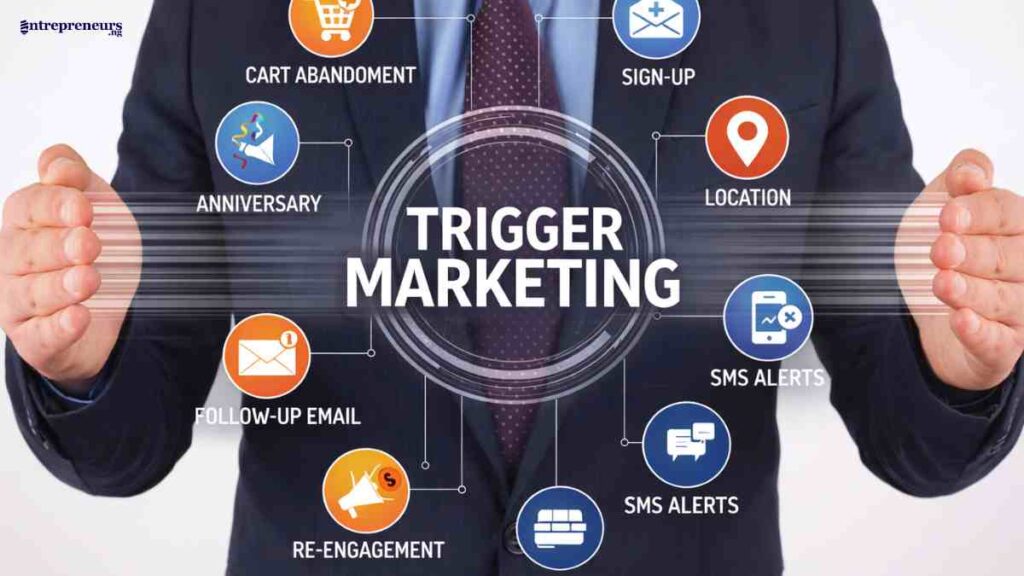
Most marketing fails because it reaches customers at the wrong moment. Trigger marketing fixes this by responding instantly to real actions, like product views, abandoned carts, sign-ups, or inactivity.
A recent McKinsey report found that 71% of consumers expect personalisation, while 76% feel frustrated without it, making trigger-based campaigns essential for trust, conversions, and impact.
In this guide, you will discover what trigger marketing is, how it works, best practices, and a step-by-step strategy to build high-converting trigger-based campaigns.
Key Takeaways
- Trigger marketing delivers the right message at the exact moment a customer is most likely to act.
- Behavioural data and automation power highly personalised, high-converting marketing experiences.
- Successful trigger-based campaigns rely on timing, relevance, and deep customer journey mapping.
- Businesses that master trigger marketing gain higher engagement, retention, and long-term revenue growth.

What Is Trigger Marketing?
Trigger marketing is a modern marketing approach that responds to real customer actions in real time.
Instead of relying on fixed schedules, businesses engage customers based on what they do, whether that is visiting a page, abandoning a cart, or completing a purchase.
This shift from planned campaigns to behaviour-driven communication allows brands to be more relevant, timely, and effective.
The Core Concept Behind Trigger Marketing
Trigger marketing is a strategy where marketing messages are automatically activated by specific customer behaviours, events, or conditions.
These triggers act as signals of intent. When a user performs an action, the system responds with a tailored message that aligns with that moment.
This creates a more natural and personalised experience, rather than interruptive or generic communication.
At its core, trigger marketing is built on a simple principle: relevance increases when timing and intent align.
Unlike traditional campaigns that are sent to large audiences at once, it focuses on individuals. It uses data to ensure that each message feels purposeful and connected to the customer’s journey.
How Trigger Marketing Works
Trigger marketing works through a combination of customer data, predefined rules, and automation systems.
These elements come together to create a seamless flow of communication that reacts instantly to user behaviour.
The process begins when a customer interacts with a brand. This interaction is tracked and analysed in real time. Once it matches a predefined condition, a trigger is activated, and the system delivers a relevant response.
Over time, this creates a continuous loop of engagement where communication is guided by behaviour rather than guesswork.
Typical Trigger Workflow
| Stage | What Happens | Outcome |
|---|---|---|
| Customer action | User performs an activity (e.g. views a product) | Behaviour is recorded |
| Trigger activation | System detects predefined condition | Trigger is fired |
| Automated response | Message is sent instantly | Customer receives relevant communication |
| Feedback loop | System tracks engagement | Future actions are refined |
This structure allows businesses to scale personalised communication without manual effort. More importantly, it ensures consistency, as every customer receives timely responses based on their actions.
Trigger Marketing vs Traditional Marketing
Understanding the difference between trigger marketing and traditional marketing highlights why many businesses are shifting towards this approach.
Traditional marketing relies on scheduled campaigns and broad messaging, while trigger marketing focuses on real-time behaviour and individual relevance.
Key Differences
| Feature | Trigger Marketing | Traditional Marketing |
|---|---|---|
| Timing | Real-time and behaviour-driven | Fixed and calendar-based |
| Targeting | Individual and personalised | Broad audience segments |
| Approach | Reactive and dynamic | Planned and static |
| Data Usage | Behavioural and real-time | Limited and historical |
| Customer Experience | Contextual and relevant | Often generic |
| Performance | Higher engagement and conversions | Lower due to timing gaps |
What This Means in Practice
In traditional marketing, a business might send a promotional email every Friday, regardless of customer behaviour.
In contrast, trigger marketing sends a message only when there is a reason to act, such as when a user shows interest in a product.
This difference is significant. Trigger marketing aligns communication with intent, making it more effective and less intrusive.
As customer expectations continue to evolve, this approach is quickly becoming the standard for delivering meaningful marketing experiences.
Types of Trigger Marketing
Trigger marketing is not a one-size-fits-all strategy. It works across different stages of the customer journey, using various signals to initiate timely and relevant communication.
Understanding the different types of triggers helps businesses design campaigns that feel natural, personalised, and effective.
Behavioural Triggers
Behavioural triggers are based on what users do, their actions, clicks, and interactions with your brand.
These are among the most powerful triggers because they reflect real intent.
For instance, when a user browses a product, clicks a link, or spends time on a pricing page, they are signalling interest. Trigger marketing captures this moment and responds immediately.
A typical example is a cart abandonment email. A customer adds an item to their cart but leaves without completing the purchase. Within hours, they receive a reminder, sometimes with an incentive.
Behavioural triggers are effective because they respond to live interest, not assumptions.
Transactional Triggers
Transactional triggers are activated by completed actions or exchanges between the customer and the business.
These include:
- Purchases
- Payment confirmations
- Order updates
- Subscription renewals
Although these messages are often considered operational, they present strong marketing opportunities. A simple order confirmation email, for example, can include product recommendations or loyalty rewards.
Because these messages are expected and opened frequently, they often achieve higher engagement rates than standard campaigns.
Lifecycle Triggers
Lifecycle triggers focus on where the customer is in their journey with your brand.
From the moment someone discovers your business to when they become a loyal customer, different triggers can guide and nurture the relationship.
Examples include:
- Welcome emails for new users
- Onboarding sequences
- Re-engagement campaigns for inactive users
- Loyalty rewards for repeat customers
This type of trigger marketing ensures that communication evolves with the customer, making each interaction feel relevant to their stage.
Time-Based Triggers
Specific dates or time intervals activate time-based triggers.
These triggers rely less on behaviour and more on timing, but they can still feel highly personal when used correctly.
Common examples include:
- Birthday or anniversary messages
- Subscription renewal reminders
- Follow-ups after a set period of inactivity
While simple, these triggers are effective because they show awareness and consistency. However, they work best when combined with behavioural insights for added relevance.
Contextual Triggers
Contextual triggers are based on external or real-time conditions that influence customer behaviour.
These may include:
- Location (e.g. nearby store offers)
- Device type (mobile vs desktop experience)
- Weather conditions (e.g. promoting umbrellas during rain)
- Time of day
For example, a ride-hailing app may send a notification during peak hours when demand is high. Similarly, a retail brand might promote seasonal products based on weather changes.
Contextual triggers add another layer of sophistication by aligning marketing with the customer’s current environment.
Quick Comparison of Trigger Types
| Trigger Type | What Activates It | Best Use Case |
|---|---|---|
| Behavioural | User actions | Conversions and engagement |
| Transactional | Completed actions | Upselling and retention |
| Lifecycle | Customer journey stage | Relationship building |
| Time-Based | Dates and intervals | Consistency and reminders |
| Contextual | External conditions | Real-time relevance |
Each type of trigger marketing serves a distinct purpose.
However, the real advantage comes when businesses combine them into a coordinated strategy, creating seamless and personalised experiences across every touchpoint.

How to Build a Winning Trigger Marketing Strategy
Building a winning trigger marketing strategy starts with understanding one simple truth: triggers only work when they reflect real customer behaviour and lead to useful, well-timed communication.
It is not enough to automate messages. You need to design a system that follows the customer journey, responds to intent, and moves people closer to action.
Here is a clear step-by-step breakdown of how to do it well.
Step 1: Map the Customer Journey
The first step is to understand how people move from awareness to purchase and beyond.
Look closely at every major stage of the customer journey, from the first website visit to repeat purchases, renewals, and re-engagement.
This helps you identify where customers need guidance, reassurance, or a nudge to act. Without this map, your trigger marketing will feel random instead of strategic.
| Customer Stage | What the Customer Is Doing | What the Brand Should Focus On |
|---|---|---|
| Awareness | Discovering your brand | Capture attention and interest |
| Consideration | Comparing options | Build trust and answer objections |
| Conversion | Ready to act | Remove friction and drive action |
| Retention | Returning after purchase | Strengthen loyalty and repeat sales |
| Re-engagement | Becoming inactive | Win attention back |
Step 2: Identify Key Trigger Points
Once the journey is clear, the next step is to find the moments that should activate communication. These are the points where a customer action, delay, or milestone signals intent or risk.
A user viewing a pricing page, abandoning a cart, signing up for a trial, or going inactive for 30 days are all examples of meaningful trigger points.
Focus on moments that matter most to revenue, retention, and customer experience.
Step 3: Segment Your Audience
Not every customer should receive the same message, even if they trigger the same action. A new visitor and a loyal customer may both browse a product page, but they need different messaging.
That is why segmentation matters. Group users by behaviour, lifecycle stage, purchase history, interests, or level of engagement.
This allows your trigger campaigns to feel more precise and personal.
| Segmentation Type | Example | Importance |
|---|---|---|
| Behavioural | Viewed product but did not buy | Shows real interest |
| Lifecycle | New lead or repeat customer | Matches message to stage |
| Purchase History | First-time buyer or loyal customer | Improves relevance |
| Engagement Level | Active or inactive subscriber | Guides tone and offer |
Step 4: Choose the Right Channels
A strong trigger marketing strategy does not rely on one channel alone. The right message also needs the right delivery method.
Email works well for onboarding, reminders, and follow-ups. SMS is useful for urgent updates or short offers. Push notifications can drive quick action inside apps.
In some cases, retargeting ads or in-app messages may work better. The key is to match the channel to the customer’s context and the urgency of the message.
Step 5: Build Automated Workflows
After defining the trigger points and channels, create workflows that determine what happens next. Each workflow should include the trigger, the message, the timing, and any follow-up actions.
For example, if a customer abandons a cart, the first email may go out after one hour, the second after 24 hours, and the third may include a gentle incentive.
A workflow should feel logical and helpful, not aggressive or repetitive.
| Trigger Event | First Response | Next Step |
|---|---|---|
| Cart abandonment | Reminder email | Discount follow-up if no action |
| New sign-up | Welcome email | Onboarding sequence |
| Inactivity | Re-engagement email | Special offer or survey |
| Purchase completed | Confirmation email | Cross-sell recommendation |
Step 6: Write Personalised, Useful Messages
The success of trigger marketing depends heavily on message quality. Even the best automation will fail if the message feels generic or pushy.
Keep your copy relevant to the user’s action and make the value clear. Speak to what the customer just did, what they may need next, and why acting now makes sense.
Strong trigger messages feel like good service, not sales pressure.
Step 7: Set Timing Rules Carefully
Timing is what gives trigger marketing its edge. A follow-up sent too late loses relevance, while one sent too soon can feel intrusive. This is why timing rules matter.
Decide how quickly each trigger should fire and how many follow-up messages are appropriate.
Test the delay between actions and responses to find the sweet spot between helpful and overwhelming.
Step 8: Track Performance and Optimise
No trigger marketing strategy is complete without measurement. Once your campaigns go live, monitor how people respond.
Track open rates, click-through rates, conversions, revenue per message, unsubscribe rates, and re-engagement results. This shows what is working and what needs improvement.
You may discover that one trigger performs well on email but better on SMS, or that certain messages need a stronger call to action.
Step 9: Refine and Scale
After testing your first set of campaigns, refine them based on the data. Improve subject lines, change timing, adjust offers, or personalise content further.
Once you have a few high-performing workflows, scale them across more touchpoints and customer segments.
This is where trigger marketing starts becoming a true growth system rather than just an automation tactic.
A Simple Framework to Remember
To build a winning trigger marketing strategy, follow this order:
| Step | Action | Goal |
|---|---|---|
| 1 | Map the customer journey | Understand decision points |
| 2 | Identify trigger moments | Find high-impact actions |
| 3 | Segment the audience | Improve relevance |
| 4 | Choose the right channels | Match message to context |
| 5 | Build workflows | Automate responses |
| 6 | Personalise the message | Increase engagement |
| 7 | Optimise timing | Improve response rates |
| 8 | Measure results | Find what works |
| 9 | Refine and scale | Grow performance over time |
A winning trigger marketing strategy is built step by step, not all at once.
When you combine customer insight, smart timing, relevant messaging, and ongoing optimisation, trigger marketing becomes more than automation.
It becomes a reliable way to increase engagement, improve customer experience, and drive stronger business results.
Why Does Trigger Marketing Work?
Trigger marketing works because it aligns perfectly with how people think, decide, and act.
It combines behavioural psychology with real-time data, allowing brands to engage customers at moments when they are already primed to respond.
Instead of interrupting people, trigger marketing fits naturally into their decision-making process. That is what makes it powerful.
The Power of Timing: Catching Intent in the Moment
One of the biggest reasons trigger marketing works is timing. People are far more likely to act when their interest is fresh.
When a customer views a product, signs up for a service, or abandons a cart, they are already in a decision-making state. A well-timed message at that moment feels helpful rather than intrusive.
Traditional marketing often misses this window. Trigger marketing captures it.
Relevance and Personalisation: Speaking Directly to the Customer
People respond to messages that feel relevant to them. Trigger marketing uses behavioural data to personalise communication based on what the customer has actually done.
Instead of sending generic promotions, businesses can say:
- “You left this item in your cart”
- “Here is something similar to what you viewed”
- “Welcome, here is how to get started”
This level of relevance increases engagement because it reduces the mental effort required to understand the message.
Behavioural Psychology: Why People Respond to Triggers
Trigger marketing works because it taps into key psychological principles that influence human behaviour, such as
1. Recency Effect
People remember and respond better to recent actions. If someone just viewed a product, a follow-up message feels like a natural continuation of that action.
2. Intent-Based Decision Making
When users take an action, they signal intent. Trigger marketing responds to that intent instead of guessing, making the message more persuasive.
3. Cognitive Ease
Relevant messages are easier to process. When a message reflects what a user has already done, it requires less thinking, increasing the likelihood of action.
4. Loss Aversion
People are motivated to avoid missing out. Messages like “Your cart is waiting” or “Only a few items left” subtly encourage action.
Reduced Friction: Making Decisions Easier
Another reason trigger marketing works is that it removes barriers to action.
Instead of forcing customers to search again or restart their journey, trigger messages bring them back to where they left off. This reduces effort and increases conversions.
For example:
- A cart reminder takes the user directly back to checkout
- A re-engagement email highlights what they missed
- A recommendation engine surfaces relevant options instantly
The easier it is to act, the more likely people are to follow through.
Data-Driven Precision: Learning and Improving Over Time
Trigger marketing is not static. It improves with data. Every interaction provides insight into:
- What customers respond to
- When they are most active
- Which messages drive action
This allows businesses to continuously refine their campaigns. Over time, triggers become more accurate, more personalised, and more effective.
According to Salesforce, a large percentage of customers expect companies to understand their needs and expectations. Trigger marketing delivers on this expectation by using real data instead of assumptions.
Emotional Connection: From Marketing to Experience
Finally, trigger marketing works because it feels less like marketing and more like a service.
When done right, it shows that a brand:
- Notices customer behaviour
- Understands their needs
- Responds in a helpful way
This builds trust and strengthens relationships. Customers are more likely to engage with brands that feel attentive rather than intrusive.
In summary, trigger marketing succeeds because it combines:
- Timing (reaching customers at the right moment)
- Relevance (based on real behaviour)
- Psychology (aligned with how people think and act)
- Data (continuously improving performance)
When these elements work together, marketing stops being noise and starts becoming a meaningful interaction that drives results.

Trigger Marketing Best Practices
Trigger marketing can deliver powerful results, but only when it is executed with precision and intent.
Simply setting up automated responses is not enough. To truly win, businesses must focus on relevance, timing, and continuous optimisation.
Below are the best practices that separate high-performing trigger campaigns from those that feel generic or ineffective.
Focus on High-Intent Moments First
Not all triggers are equal. Some actions signal stronger intent than others, and these should be prioritised.
For example, a customer who visits a pricing page or abandons a cart is far more likely to convert than someone casually browsing a homepage.
By focusing on these high-impact moments, you maximise results without overwhelming your audience.
Start with triggers that directly influence revenue, such as:
- Cart abandonment
- Product views
- Sign-ups
- Checkout drop-offs
Once these are optimised, you can expand into other trigger types.
Make Personalisation Meaningful, Not Superficial
Adding a customer’s name is not enough. True personalisation comes from understanding behaviour, preferences, and context.
Effective trigger marketing speaks to what the customer actually did. It reflects their journey and anticipates their next step. This makes the message feel helpful rather than promotional.
Instead of generic messaging, aim for:
- Behaviour-based recommendations
- Context-aware offers
- Content tailored to user intent
The more relevant the message, the higher the engagement.
Get the Timing Right
Timing is the foundation of trigger marketing. Even a well-crafted message will fail if it arrives too late or too early.
A cart reminder sent within an hour can recover a sale. The same message sent days later may be ignored. On the other hand, sending too many messages too quickly can feel intrusive.
To optimise timing:
- Test different delays between trigger and response
- Adjust based on customer behaviour patterns
- Avoid overwhelming users with repeated messages
Finding the right balance is key to maintaining trust and effectiveness.
Use Multi-Channel Triggers Strategically
Customers interact with brands across multiple platforms. Relying on a single channel limits your impact.
A strong trigger marketing strategy uses the right channel for the right situation. Email may work well for detailed communication, while SMS or push notifications are better for urgency.
For example:
- Email for onboarding and education
- SMS for time-sensitive reminders
- Push notifications for instant engagement
The goal is not to use every channel, but to use each one intentionally and effectively.
Design Clear and Logical Workflows
Trigger marketing should feel seamless, not chaotic. Every trigger must follow a clear path that guides the customer logically.
A good workflow anticipates what happens next. If a user ignores the first message, what follows? If they engage, what is the next step?
Strong workflows:
- Have a defined sequence of actions
- Avoid duplication or overlap
- Adapt based on user response
This creates a smooth experience that moves customers forward without confusion.
Avoid Over-Automation
Automation is powerful, but too much of it can damage the customer experience.
If users receive too many messages, especially within a short period, they may feel overwhelmed or even annoyed. This can lead to disengagement or unsubscribes.
To avoid this:
- Set limits on how often messages are sent
- Prioritise quality over quantity
- Ensure every message delivers value
Trigger marketing should feel like assistance, not pressure.
Continuously Test and Optimise
No trigger marketing strategy is perfect from the start. The best-performing campaigns are constantly refined based on real data.
Test different elements such as:
- Subject lines
- Message content
- Timing intervals
- Offers and incentives
Small improvements can lead to significant gains over time. What works today may not work tomorrow, so ongoing optimisation is essential.
Align Triggers with the Customer Journey
Trigger marketing works best when it reflects where the customer is in their journey.
A new user needs guidance. A returning customer may need recommendations. An inactive user may need re-engagement.
When triggers align with these stages, communication feels natural and relevant. This improves both customer experience and results.
Track the Right Metrics
Success in trigger marketing is not just about sending messages. It is about measuring impact.
Focus on metrics that reflect real performance, such as:
- Conversion rates
- Click-through rates
- Engagement levels
- Customer retention
- Revenue generated per trigger
Tracking these metrics helps you understand what is working and where to improve.
Prioritise Value in Every Interaction
Above all, every trigger should provide value. If a message does not help the customer, it should not be sent.
Ask yourself:
- Does this message solve a problem?
- Does it guide the customer forward?
- Does it make the experience better?
When value is consistent, customers begin to trust and even expect your communication.
Examples of Trigger Marketing
Trigger marketing comes to life through practical, real-world applications. These triggers are based on specific customer actions, behaviours, or events that signal intent.
When used correctly, they help businesses respond at the right moment with relevant and timely communication.
Below is a clear overview of common trigger marketing examples and how they are used.
| Trigger Event | What Happens | Typical Response | Goal |
|---|---|---|---|
| Cart abandonment | Customer adds item to cart but leaves | Reminder email or discount offer | Recover lost sales |
| Product view | User browses a product page | Follow-up email with similar products | Encourage purchase |
| New sign-up | User registers or subscribes | Welcome email or onboarding series | Build relationship |
| Purchase completed | Customer completes a transaction | Thank-you message with recommendations | Upsell or cross-sell |
| Inactivity | User has not engaged for a period | Re-engagement email or special offer | Win back attention |
| Birthday or anniversary | Customer reaches a milestone date | Personalised message or reward | Strengthen loyalty |
| Subscription renewal | Renewal date is approaching | Reminder notification | Prevent churn |
| App download | User installs an app | Onboarding push notifications | Increase usage |
| Pricing page visit | User views pricing details | Targeted offer or sales follow-up | Drive conversion |
| Location-based action | User enters a specific area | Localised promotion or alert | Increase relevance |
These examples show how trigger marketing transforms everyday customer actions into meaningful engagement opportunities.
The key is not just identifying the trigger, but responding in a way that feels helpful, timely, and aligned with the customer’s needs.
Top Tools for Trigger Marketing (Automation Platforms That Power Results)
Trigger marketing relies heavily on the right tools to track behaviour, automate responses, and deliver personalised messages at scale.
These platforms help businesses turn customer data into real-time actions, ensuring that every trigger leads to meaningful engagement.
Below is a curated list of widely used tools and how they support trigger-based marketing.
| Tool | What It Does | Best For | Key Strength |
|---|---|---|---|
| HubSpot | All-in-one CRM with marketing automation | Small to mid-sized businesses | Easy-to-use workflows and segmentation |
| Salesforce Marketing Cloud | Advanced customer data and automation platform | Large enterprises | Deep personalisation and scalability |
| ActiveCampaign | Email marketing + automation | SMEs and digital businesses | Strong behavioural automation features |
| Klaviyo | eCommerce-focused automation | Online stores | Powerful revenue-driven triggers |
| Mailchimp | Email marketing and basic automation | Beginners and startups | Simple setup and user-friendly interface |
| Customer.io | Behavioural messaging platform | SaaS and tech companies | Real-time, event-based messaging |
| Braze | Cross-channel customer engagement | Mobile-first businesses | Strong push and in-app messaging |
| MoEngage | Insights-led engagement platform | Global brands and apps | Advanced analytics and AI triggers |
| Iterable | Growth marketing platform | Scaling businesses | Omnichannel campaign orchestration |
| Omnisend | Marketing automation for eCommerce | Retail and DTC brands | Email, SMS, and push in one platform |
These tools form the backbone of any effective trigger marketing strategy. The right choice depends on your business size, goals, and the level of personalisation you want to achieve.
However, regardless of the platform, the goal remains the same: to deliver the right message at the right time, automatically.

How to Measure Success in Trigger Marketing
Trigger marketing is only as effective as the results it delivers. To understand what is working and what needs improvement, businesses must track the right performance metrics.
These metrics go beyond basic engagement and focus on actual impact, conversions, revenue, and customer retention.
Below is a structured view of the key metrics used to measure trigger marketing success.
| Metric | What It Measures | Importance | What Good Looks Like |
|---|---|---|---|
| Open Rate | Percentage of users who open messages | Shows effectiveness of timing and subject lines | Higher than regular campaigns |
| Click-Through Rate (CTR) | Users who click on links | Indicates message relevance and interest | Strong engagement with content |
| Conversion Rate | Users who complete desired action | Measures real business impact | Direct link to revenue growth |
| Revenue per Trigger | Income generated from each trigger | Tracks financial performance | Increasing over time |
| Engagement Rate | Overall interaction (clicks, replies, etc.) | Reflects message effectiveness | Consistent or improving |
| Unsubscribe Rate | Users opting out | Signals message fatigue or irrelevance | Low and stable |
| Customer Retention Rate | Repeat engagement or purchases | Shows long-term value of triggers | High retention levels |
| Time to Conversion | How quickly users take action | Indicates efficiency of triggers | Shorter time frames |
Focus on Metrics That Drive Real Growth
While open rates and clicks are useful, they do not tell the full story. The most important question is: Are your triggers driving action and revenue?
For example:
- A cart abandonment email with a high open rate but low conversions needs improvement
- A re-engagement campaign that brings inactive users back is a strong success signal
Always prioritise metrics tied to business outcomes, not just activity.
Measure Performance by Trigger Type
Not all triggers perform the same way. Each type should be evaluated based on its purpose.
| Trigger Type | Primary Metric to Track |
|---|---|
| Cart abandonment | Conversion rate |
| Welcome/onboarding | Engagement rate |
| Re-engagement | Retention rate |
| Transactional | Upsell or cross-sell revenue |
| Behavioural (product views) | Click-through rate |
This approach ensures you are measuring success in context, not using a one-size-fits-all standard.
Use Data to Improve Continuously
Measuring success is not a one-time task. It is an ongoing process of testing and refining.
Track performance over time and look for patterns:
- Which triggers convert best?
- Which messages are ignored?
- What timing produces the highest engagement?
Use these insights to adjust messaging, improve timing, refine segmentation and optimise workflows.
A Simple Rule to Remember
A trigger marketing campaign is successful when it:
- Reaches the customer at the right time
- Delivers a relevant message
- Leads to a measurable action
If your triggers consistently meet these three conditions, your strategy is working.
The Future of Trigger Marketing
Trigger marketing is evolving rapidly as technology advances and customer expectations continue to rise.
What started as simple automated responses is now becoming a sophisticated system driven by artificial intelligence, real-time data, and predictive insights.
In the future, trigger marketing will not just react to behaviour; it will anticipate it, enabling businesses to engage customers even before they take action.
Below is a clear look at the key trends shaping the future of trigger marketing.
| Trend | What It Means | Impact on Businesses |
|---|---|---|
| AI-Powered Predictive Triggers | Systems predict customer behaviour before it happens | Proactive engagement and higher conversions |
| Real-Time Personalisation | Instant adaptation of messages based on live data | More relevant and timely experiences |
| Omnichannel Integration | Seamless triggers across email, SMS, apps, and ads | Consistent customer journey across platforms |
| Customer Data Platforms (CDPs) | Unified view of customer data from multiple sources | Better targeting and deeper insights |
| Privacy-First Marketing | Stricter data regulations and consent-based tracking | More transparent and trust-driven strategies |
| Hyper-Personalisation | Tailoring content to individual preferences at scale | Stronger engagement and loyalty |
| Automation + Human Touch Balance | Smarter automation with human-like messaging | More authentic customer interactions |
| Voice and Conversational Triggers | Integration with voice assistants and chatbots | New channels for real-time engagement |
The future of trigger marketing is not just about automation, but about intelligence and empathy at scale.
Businesses that embrace these trends will move beyond reactive messaging and create experiences that feel intuitive, helpful, and deeply personalised.
Conclusion
Trigger marketing is no longer a nice-to-have; it is a core strategy for businesses that want to stay relevant, responsive, and competitive.
By combining data, timing, and personalisation, it transforms everyday customer actions into meaningful opportunities for engagement and growth.
We want to see you succeed, and that’s why we provide valuable business resources to help you every step of the way.
- Join over 23,000 entrepreneurs by signing up for our newsletter and receiving valuable business insights.
- Register your business today with Entrepreneurs.ng’s Business Registration Services.
- Tell Your Brand Story on Entrepreneurs.ng, let’s showcase your brand to our global audience.
- Need help with your marketing strategy? Get a Comprehensive Marketing and Sales Plan here.
- Sign up for our Entrepreneurs Success Blueprint Programme to learn how to start and scale your business in just 30 days.
- Book our one-on-one consulting and speak to an expert about structuring and growing your business.
- Visit our shop for business plan templates and other valuable resources to guide you.
- Get our Employee-Employer Super Bundle NDA templates to legally protect your business and workforce.
- Advertise your business to over a million entrepreneurs through our different advertising packages.

Frequently Asked Questions (FAQs)
What is trigger marketing in simple terms?
Trigger marketing is a strategy where businesses send messages based on customer actions or events, ensuring communication is timely and relevant.
How does trigger marketing work?
It works by tracking customer behaviour, setting predefined triggers, and automatically sending messages when those triggers are activated.
What are examples of trigger marketing?
Common examples include cart abandonment emails, welcome messages, re-engagement campaigns, and personalised product recommendations.
Why is trigger marketing effective?
It works because it targets customers at the right moment, when they are most likely to engage or take action.
What is the difference between trigger marketing and traditional marketing?
Trigger marketing is behaviour-based and real-time, while traditional marketing relies on scheduled, broad campaigns.
What are behavioural triggers in marketing?
These are triggers based on user actions, such as clicking a link, viewing a product, or abandoning a cart.
What tools are used for trigger marketing?
Popular tools include HubSpot, Salesforce Marketing Cloud, ActiveCampaign, and Klaviyo.
Is trigger marketing only for email campaigns?
No, it works across multiple channels including SMS, push notifications, in-app messages, and ads.
What industries benefit most from trigger marketing?
E-commerce, SaaS, fintech, travel, and media companies benefit greatly due to frequent customer interactions.
How do you create a trigger marketing campaign?
Start by mapping the customer journey, identifying trigger points, setting up automation workflows, and optimising performance.
What is a trigger in marketing automation?
A trigger is a specific action or condition that initiates an automated response, such as sending a message.
Can trigger marketing improve customer retention?
Yes, by engaging customers at the right time, it helps build relationships and encourages repeat interactions.
What are common mistakes in trigger marketing?
Over-automation, poor timing, lack of personalisation, and ignoring data insights are common issues.
How do you measure trigger marketing success?
You track metrics like conversion rates, click-through rates, engagement levels, and revenue generated.
Is trigger marketing suitable for small businesses?
Yes, even small businesses can use simple automation tools to implement effective trigger campaigns.
What is the future of trigger marketing?
It is moving towards AI-driven, predictive, and highly personalised experiences across multiple channels.