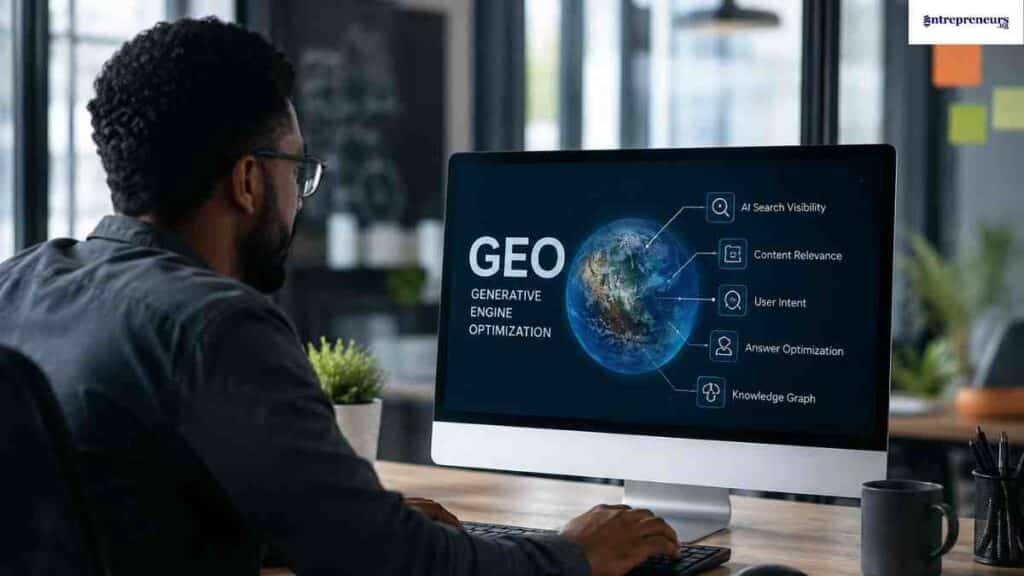
Generative engine optimisation is reshaping how businesses gain visibility online.
With people turning to AI tools like ChatGPT, Gemini, and Google AI Overviews for answers, success depends not only on rankings but also on AI visibility and discoverability.
Research from Princeton collaborators found that GEO techniques can improve visibility in generative engine responses by up to 40%, highlighting the growing importance of AI search optimisation and GEO best practices.
In this guide, you will learn how Generative search optimisation works, how to get cited by AI, and the AI search optimisation strategies businesses can use to stay visible in the future of search.
Key Takeaways
- Generative Engine Optimisation helps your content become a trusted source that AI platforms can cite, recommend, and reference.
- GEO complements traditional SEO by focusing on AI visibility and discoverability, not just search rankings.
- Brands that publish authoritative, well-structured, and evidence-backed content are more likely to appear in AI-generated answers.
- As AI search reshapes online discovery, businesses that adopt GEO early will gain a significant competitive advantage.s

What Is Generative Engine Optimisation?
Generative Engine Optimisation (GEO) is the process of optimising content so that artificial intelligence platforms such as ChatGPT, Google AI Overviews, Gemini, Claude, and Perplexity can easily find, understand, trust, and cite it in their responses.
Unlike traditional SEO, which focuses on improving rankings in search engine results pages, GEO focuses on increasing the chances of your content being referenced in AI-generated answers.
GEO helps brands build authority, improve AI discoverability, and position themselves as trusted sources in an era where answers are increasingly generated rather than simply searched.
Here’s a structured section that fits the tone and depth of the article:
Origins of the GEO Concept
Generative Engine Optimisation did not emerge overnight.
It evolved in response to one of the biggest shifts in digital discovery since the birth of search engines: the rise of artificial intelligence as a primary source of information.
As users increasingly turned to AI-powered platforms for answers, marketers and publishers began looking for ways to ensure their content remained visible in this new environment.
From Search Engines to Answer Engines
For decades, traditional SEO focused on helping websites rank higher in search engine results. Success depended largely on factors such as keywords, backlinks, site authority, and user experience.
However, the emergence of generative AI tools changed how people access information. Instead of presenting a list of links, platforms like ChatGPT, Gemini, Claude, and Perplexity began generating direct answers to users’ questions.
This shift created a new challenge: how can brands remain visible when users no longer need to click through multiple webpages?
The answer was a new optimisation approach designed specifically for AI-driven search experiences.
The Research That Introduced GEO
The term “Generative Engine Optimisation” gained widespread attention in 2023 following a landmark study by researchers from Princeton University, Georgia Tech, The Allen Institute for AI, and IIT Delhi.
Their paper, titled GEO: Generative Engine Optimisation, explored how content creators could improve the visibility of their content within AI-generated responses.
The researchers found that certain optimisation techniques, including the use of statistics, citations, quotations, and authoritative language, significantly increased the likelihood of content being referenced by generative engines. In some cases, visibility improved by as much as 40%.
This research provided the first formal framework for understanding how content could be optimised not just for search engines, but also for AI systems.
Why GEO Became Necessary
As AI-powered search continues to evolve, businesses can no longer rely solely on traditional SEO tactics. Ranking on the first page of Google remains important, but it is no longer enough to guarantee visibility.
Today, brands must also consider how AI systems discover, evaluate, and select information when generating answers.
GEO emerged to address this challenge, helping organisations create content that is not only searchable but also understandable, trustworthy, and cite-worthy in the eyes of AI.
The Beginning of a New Visibility Era
The introduction of GEO marks the beginning of a new chapter in digital marketing.
Just as SEO became essential during the search engine era, Generative Engine Optimisation is becoming increasingly important in the age of AI-driven discovery.
Businesses that understand this shift early will be better positioned to build authority, earn AI citations, and maintain visibility as search behaviour continues to evolve.
The Evolution of Search
The way people find information online has changed dramatically over the past three decades.
Search has evolved from simple keyword matching to intelligent systems capable of understanding context, intent, and natural language.
Understanding this evolution helps explain why Generative Engine Optimisation (GEO) has become necessary.
The Search Engine Era
The early internet relied on search engines such as Yahoo, AltaVista, and later Google to help users navigate the growing web.
These platforms ranked webpages based on factors like keyword relevance, backlinks, and site authority.
For businesses, visibility depended on appearing as high as possible in search engine results pages (SERPs). This gave rise to Search Engine Optimisation (SEO), which became the cornerstone of digital marketing.
During this era, users typically entered short queries such as “best CRM software” or “how to start a business” and clicked through multiple websites to find answers.
The Mobile Search Era
The introduction of smartphones transformed search behaviour. People began searching on the go, using shorter queries and expecting faster results.
Google responded by prioritising mobile-friendly websites and improving local search capabilities. Businesses had to optimise for mobile experiences, page speed, and location-based searches to remain competitive.
Search was no longer limited to desktop computers; it became an everyday activity integrated into people’s lives.
The Voice Search Era
The rise of digital assistants such as Siri, Alexa, and Google Assistant introduced a new way of searching. Instead of typing keywords, users began asking complete questions in natural language.
For example, rather than searching for “weather London”, users would ask, “What will the weather be like in London tomorrow?”
This shift encouraged marketers to focus more on conversational keywords, question-based content, and featured snippets that could be read aloud by voice assistants.
The AI Search Era
Today, search is entering its most transformative phase yet. Generative AI platforms such as ChatGPT, Gemini, Claude, Microsoft Copilot, and Perplexity can provide direct, conversational answers instead of simply displaying a list of links.
Users no longer need to visit multiple websites to gather information. AI systems can analyse data from various sources, summarise key points, and generate tailored responses within seconds.
This shift has fundamentally changed online visibility. Businesses now need to optimise not only for search engines but also for AI systems that decide which sources to reference, cite, or recommend.
This is where Generative Engine Optimisation comes into play.
What Comes Next?
The future of search is likely to be even more personalised, conversational, and autonomous.
AI agents will not only answer questions but may also perform tasks, conduct research, compare products, and make recommendations on behalf of users.
As this transition accelerates, authority, trustworthiness, and content quality will become even more important than traditional ranking signals.
Businesses that create valuable, well-structured, and evidence-backed content will be better positioned to thrive in this new era of AI-driven discovery.
The evolution of search shows a clear trend: users are moving from searching for information to receiving answers. GEO is the next step in ensuring your content remains visible as that transformation continues.

How Generative Search Engines Work
Generative search engines represent a major shift from traditional search.
Instead of simply displaying a list of webpages, they analyse information from multiple sources, understand the user’s intent, and generate direct answers in a conversational format.
To understand why Generative Engine Optimisation matters, it is important to understand how these systems work behind the scenes.
Large Language Models: The Engine Behind AI Search
At the heart of generative search are Large Language Models (LLMs). These are advanced AI systems trained on vast amounts of text from books, websites, research papers, and other publicly available information.
Their primary function is to understand language patterns and generate human-like responses.
When a user asks a question, the model predicts the most relevant answer based on the information it has learned and the sources it can access.
This allows AI platforms to respond in natural language rather than presenting users with a list of blue links.
Retrieval-Augmented Generation (RAG)
Many modern AI search platforms use a technique known as Retrieval-Augmented Generation (RAG).
Rather than relying solely on pre-trained knowledge, RAG enables the AI to retrieve relevant information from external sources in real time before generating a response.
Think of it as a researcher who quickly gathers information from trusted references before answering a question.
This approach helps improve:
- Accuracy
- Relevance
- Freshness of information
- Source attribution
It also explains why some websites are cited more frequently than others.
Understanding User Intent
Generative search engines do more than analyse keywords. They aim to understand the context and purpose behind a query.
For example, a search for “best project management software” could indicate that the user wants:
- Product recommendations
- Feature comparisons
- Pricing information
- User reviews
The AI evaluates the intent behind the question and generates a response that directly addresses the user’s needs.
This is why content that answers questions clearly and comprehensively tends to perform better in AI-driven search environments.
Information Retrieval and Source Evaluation
Before generating an answer, the AI identifies potentially relevant sources. It then evaluates those sources based on factors such as:
- Authority
- Expertise
- Trustworthiness
- Relevance
- Freshness
- Content quality
Websites that consistently publish accurate, well-structured, and evidence-backed content are more likely to be selected during this process.
In many ways, this resembles traditional SEO, but with a stronger emphasis on content quality and factual reliability.
Content Synthesis and Answer Generation
Once relevant information has been gathered, the AI synthesises it into a coherent response.
Unlike traditional search engines that display separate webpages, generative engines combine insights from multiple sources into a single answer.
The goal is to save users time by delivering concise, relevant information without requiring them to visit numerous websites.
This process is what makes AI search so powerful, and why earning inclusion in those responses is becoming increasingly valuable.
How Citations Are Selected
Not every source used by an AI system receives a citation. Generative engines typically favour content that demonstrates:
- Clear expertise
- Original insights
- Credible references
- Strong factual accuracy
- Well-organised structure
Research on Generative Engine Optimisation has shown that content containing statistics, citations, quotations, and authoritative language is more likely to be referenced in AI-generated answers.
This means businesses must think beyond keywords and focus on creating genuinely valuable, trustworthy content.
Why Some Sources Are Chosen More Often Than Others
AI systems are designed to minimise misinformation and maximise user trust. As a result, they tend to favour sources that consistently demonstrate authority within their field.
Several factors can increase the likelihood of selection:
- Strong brand reputation
- Expert authorship
- Original research and data
- Comprehensive topic coverage
- Consistent publishing history
- Positive mentions across the web
The more signals of credibility a brand can establish, the more likely its content will appear in AI-generated responses.
Generative search engines do not simply rank webpages, they evaluate, retrieve, interpret, and synthesise information before delivering an answer.
This changes the rules of online visibility. Success is no longer just about appearing on page one of search results; it is about becoming a trusted source that AI systems consider worthy of citing, summarising, and recommending.
GEO vs SEO: What Is the Difference?
At first glance, Generative Engine Optimisation (GEO) and Search Engine Optimisation (SEO) appear to serve the same purpose: increasing online visibility. However, they operate in different environments and focus on different outcomes.
Traditional SEO aims to improve a website’s ranking in search engine results pages. GEO, on the other hand, focuses on helping content become visible within AI-generated responses.
Instead of competing for a position on a search results page, businesses are competing to become trusted sources that AI systems cite, summarise, and recommend.
The rise of AI-powered search does not make SEO obsolete. Rather, it expands the rules of digital visibility.
Understanding the Core Difference
The fundamental difference lies in how information is delivered to users.
With traditional search, users receive a list of webpages and choose which result to visit.
With generative search, users often receive a complete answer generated from multiple sources, sometimes without needing to click any links.
This changes the optimisation objective from “ranking higher” to “being referenced.”
GEO vs SEO Comparison Table
| Factor | SEO | GEO |
|---|---|---|
| Primary Goal | Rank webpages in search results | Get cited or referenced in AI-generated answers |
| Focus | Search engine algorithms | AI models and generative engines |
| Success Metric | Rankings, clicks, organic traffic | AI citations, mentions, AI visibility |
| User Journey | Search → Click → Website | Question → AI Answer |
| Key Optimisation Target | Search results pages (SERPs) | AI-generated responses |
| Content Style | Keyword-focused and search-friendly | Context-rich, authoritative, and citation-ready |
| Importance of Backlinks | Very high | Important, but not the only authority signal |
| Importance of Brand Authority | Important | Extremely important |
| Structured Data | Helpful | Increasingly critical |
| Content Depth | Valuable | Essential |
How SEO and GEO Overlap
Despite their differences, GEO and SEO share several foundational principles.
Both reward:
- High-quality content
- Expertise and authority
- Strong user experience
- Accurate information
- Clear content structure
- Topical relevance
A website with strong SEO fundamentals already has an advantage when implementing GEO. However, AI systems often require additional trust signals before referencing content in generated responses.
Where GEO Goes Beyond Traditional SEO
While SEO largely focuses on helping search engines understand webpages, GEO focuses on helping AI systems trust and use information.
For example, a page may rank highly on Google because it targets the right keywords and has strong backlinks.
However, an AI system may still choose another source if that content provides:
- Better supporting evidence
- Stronger citations
- More comprehensive explanations
- Clearer expertise signals
- Original research or data
In other words, ranking first does not automatically mean becoming the preferred source for AI-generated answers.
Traffic vs Visibility
One of the biggest shifts introduced by GEO is the changing relationship between visibility and traffic.
Under traditional SEO, visibility and traffic were closely connected. The higher a page ranked, the more visitors it typically received.
With generative search, a brand may gain significant visibility even if users never visit its website. An AI assistant might cite a company’s research, mention its expertise, or recommend its products directly within an answer.
This creates a new metric that many marketers are beginning to track: AI visibility.
Does GEO Replace SEO?
No. GEO is not a replacement for SEO.
Search engines continue to drive billions of visits to websites every day, making SEO a critical component of any digital strategy. However, as AI-powered search grows, relying solely on SEO may limit a brand’s visibility.
The most effective approach combines both disciplines:
- SEO helps users find your website.
- GEO helps AI systems find and trust your content.
Together, they create a stronger and more resilient visibility strategy.
The Future Is GEO and SEO Working Together
Rather than viewing GEO and SEO as competing strategies, businesses should see them as complementary disciplines.
SEO builds the foundation for discoverability, while GEO expands that visibility into AI-powered ecosystems.
The brands that will dominate the next era of digital marketing are not those that choose between SEO and GEO.
They are the ones that successfully integrate both into a single content strategy built around authority, trust, and usefulness.
10 Proven Generative Engine Optimisation Strategies
As AI-powered search platforms become a primary source of information, businesses must rethink how they create and optimise content.
Unlike traditional SEO, which focuses on improving rankings in search results, Generative Engine Optimisation is about increasing the likelihood that AI systems will discover, trust, cite, and recommend your content.
The following strategies can help improve your AI visibility and strengthen your position in the emerging era of AI-driven search.
1. Create Expert-Led Content
AI systems prioritise content that demonstrates expertise, accuracy, and credibility.
Content written by subject matter experts or backed by expert insights is more likely to be trusted and referenced in AI-generated responses.
Rather than publishing generic articles, focus on providing original insights, practical experience, research-backed information, and clear explanations that solve real problems.
| Generic Content | Expert-Led Content |
|---|---|
| Repeats information from other websites | Provides unique insights and analysis |
| Offers broad advice | Shares practical experience and expertise |
| Few or no references | Includes credible sources and supporting data |
| Limited depth | Covers topics comprehensively |
Some ways to strengthen expertise signals include:
- Include author names and credentials.
- Reference credible studies and industry reports.
- Add original examples and case studies.
- Share first-hand experience where relevant.
- Regularly update content with new insights.
The more expertise your content demonstrates, the more likely AI systems are to view it as a trustworthy source worth citing.
2. Support Your Content With Original Data and Statistics
Generative engines favour content backed by evidence.
Research, surveys, industry data, and relevant statistics help AI systems assess the reliability of information and increase the likelihood of citation.
Whenever possible, include proprietary data or insights that cannot be found elsewhere. Original information helps distinguish your content from hundreds of similar articles on the same topic.
| Weak Evidence | Strong Evidence |
|---|---|
| Opinions without support | Claims backed by data |
| Generic statements | Industry-specific statistics |
| No references | Credible sources cited |
| Rewritten content | Original research and findings |
To strengthen your content:
- Include relevant statistics from trusted sources.
- Conduct surveys or gather first-hand data.
- Use charts, reports, or industry benchmarks.
- Cite authoritative studies and publications.
- Reference recent data where available.
Data-backed content not only improves credibility but also gives AI systems stronger reasons to reference your content when generating answers.
3. Answer Questions Clearly and Directly
AI search platforms are designed to provide immediate answers. Content that addresses questions directly is easier for generative engines to understand, extract, and reference.
Avoid burying answers beneath long introductions or unnecessary jargon. Instead, provide a concise answer first, then expand with supporting details.
| Less Effective | More Effective |
|---|---|
| Long-winded explanations | Direct answers upfront |
| Vague language | Clear and specific language |
| Large blocks of text | Structured sections and bullet points |
| Hidden key information | Key points stated early |
To improve answerability:
- Use question-based headings.
- Place the answer within the first few sentences.
- Break complex topics into smaller sections.
- Use bullet points for important information.
- Define technical terms in simple language.
The easier it is for AI systems to identify an answer, the easier it becomes for your content to appear in AI-generated responses.
4. Build Comprehensive Topic Coverage
Generative engines prefer content that covers a subject thoroughly. A detailed resource is often considered more valuable than several thin articles covering only fragments of a topic.
Instead of focusing on a single keyword, aim to address the main topic, related questions, common challenges, and practical applications within one comprehensive piece.
| Thin Content | Comprehensive Content |
|---|---|
| Covers one aspect of a topic | Covers the topic from multiple angles |
| Answers one question | Answers several related questions |
| Limited context | Provides context and deeper insights |
| Surface-level information | Complete and actionable guidance |
To improve topic coverage:
- Address related user questions.
- Include examples and real-world applications.
- Cover benefits, challenges, and best practices.
- Add FAQs where relevant.
- Link related content together through topic clusters.
Comprehensive content helps AI systems gain a fuller understanding of a topic, making it more likely to be selected as a reliable source.
5. Strengthen Your Brand Entity
Generative engines do not evaluate content alone; they also evaluate the entity behind the content. An entity can be a business, person, product, publication, or organisation.
The stronger and more consistent your brand presence across the web, the easier it becomes for AI systems to recognise and trust your content.
| Weak Entity Signals | Strong Entity Signals |
|---|---|
| Inconsistent brand information | Consistent brand identity across platforms |
| Limited online presence | Strong presence across multiple channels |
| Few external mentions | Frequent mentions from credible sources |
| Little authority in a niche | Recognised expertise in a niche |
To improve entity recognition:
- Maintain consistent brand information online.
- Build profiles on reputable platforms.
- Earn mentions from authoritative websites.
- Publish thought leadership content regularly.
- Showcase expertise through interviews, research, and industry contributions.
As AI search evolves, brand authority is becoming just as important as content quality.
The more recognisable your entity is, the more likely your content will be referenced in AI-generated answers.

6. Use Structured Data and Clear Content Architecture
AI systems process information more effectively when content is organised logically.
A clear structure helps generative engines understand relationships between ideas and locate important information quickly.
While structured data was originally designed for search engines, it also improves content interpretation for AI-powered systems.
| Poor Structure | Strong Structure |
|---|---|
| Unclear headings | Descriptive headings and subheadings |
| Large text blocks | Well-organised sections |
| No schema markup | Relevant structured data markup |
| Mixed topics | Logical content hierarchy |
To improve content architecture:
- Use a clear H1, H2, and H3 structure.
- Add schema markup where appropriate.
- Organise content into logical sections.
- Use lists, tables, and bullet points.
- Ensure each section covers one primary idea.
Well-structured content is easier for both humans and AI systems to understand, increasing its chances of being selected and cited.
7. Optimise for AI Retrieval
Before an AI system can cite your content, it must first be able to find and retrieve it.
Content that is easy to access, understand, and process has a better chance of being included in AI-generated responses.
Generative engines favour content that is clear, relevant, and focused on answering specific user needs.
| Difficult to Retrieve | Easy to Retrieve |
|---|---|
| Ambiguous topic focus | Clear topical focus |
| Vague headings | Descriptive headings |
| Buried answers | Answers presented early |
| Scattered information | Well-organised content |
To improve retrieval potential:
- Focus each page on a clear topic.
- Use descriptive headings and subheadings.
- Include concise summaries where appropriate.
- Answer questions directly and clearly.
- Keep information current and accurate.
The easier it is for AI systems to retrieve relevant information from your content, the greater the likelihood of appearing in AI-generated answers.
8. Publish Original Insights and Thought Leadership
AI systems are constantly exposed to content that repeats information already available online.
Content that introduces fresh ideas, unique perspectives, or original analysis stands out and is more likely to be referenced.
Thought leadership helps establish authority and positions your brand as a source of expertise rather than just another publisher.
| Generic Content | Thought Leadership Content |
|---|---|
| Repeats existing ideas | Introduces new perspectives |
| Summarises others’ opinions | Provides original analysis |
| Follows industry conversations | Shapes industry conversations |
| Little differentiation | Strong competitive advantage |
To build thought leadership:
- Share expert opinions on industry trends.
- Publish original research and findings.
- Offer unique frameworks or methodologies.
- Provide informed predictions and analysis.
- Challenge common assumptions with evidence.
The more original value your content provides, the more likely AI systems are to view it as a noteworthy source worth citing.
9. Earn High-Quality Brand Mentions Across the Web
Backlinks remain valuable, but in the age of AI search, brand mentions are becoming increasingly important.
Generative engines often assess how frequently a brand, expert, or organisation is referenced across trusted sources when evaluating authority.
A business that is consistently mentioned in credible publications is more likely to be recognised as a trusted entity.
| Weak Brand Presence | Strong Brand Presence |
|---|---|
| Few online mentions | Frequent mentions across reputable sources |
| Limited industry recognition | Established industry authority |
| Little third-party validation | Strong external endorsements |
| Low visibility beyond own website | Presence across multiple platforms |
To increase brand mentions:
- Contribute expert commentary to industry publications.
- Participate in podcasts, webinars, and interviews.
- Publish research others can reference.
- Build relationships with journalists and industry analysts.
- Encourage citations of your work through valuable content.
Strong brand recognition across the web helps AI systems associate your organisation with expertise and authority, improving the chances of being referenced in AI-generated responses.
10. Keep Content Fresh and Continuously Updated
AI systems favour information that is accurate, relevant, and up to date.
Outdated content can lose credibility over time, especially in fast-moving industries such as technology, finance, healthcare, and digital marketing.
Regular updates signal that your content remains reliable and worthy of reference.
| Outdated Content | Updated Content |
|---|---|
| Old statistics and examples | Current data and insights |
| Broken links | Functional and relevant links |
| Obsolete recommendations | Updated best practices |
| Limited relevance | Continues to address current needs |
To keep content fresh:
- Review high-performing articles regularly.
- Replace outdated statistics and references.
- Add new developments and industry trends.
- Update examples and case studies.
- Fix broken links and outdated resources.
Generative engines are designed to provide the most relevant information available.
Consistently updating your content helps maintain authority and improves the likelihood of continued visibility in AI-generated answers.
The CITE Framework for GEO Success
As Generative Engine Optimisation continues to evolve, businesses need a practical framework that goes beyond keywords and rankings.
The CITE Framework provides a simple way to understand what makes content more visible and trustworthy in AI-generated search results.
At its core, the framework focuses on four elements that AI systems consistently value when selecting sources: Credibility, Information Density, Trust Signals, and Entity Recognition.
C – Credibility
Credibility is the foundation of GEO. AI systems are more likely to reference content that demonstrates expertise, accuracy, and authority.
This means publishing content that is supported by reliable sources, written by knowledgeable contributors, and backed by verifiable facts.
Some ways to strengthen credibility include:
- Citing authoritative sources.
- Including expert insights.
- Referencing industry research.
- Providing accurate and factual information.
- Demonstrating subject matter expertise.
Without credibility, even well-written content may struggle to earn AI citations.
I – Information Density
Information density refers to the amount of valuable, relevant information contained within a piece of content.
AI systems prefer content that delivers meaningful insights rather than lengthy articles filled with repetition or fluff.
| Low Information Density | High Information Density |
|---|---|
| Generic statements | Actionable insights |
| Repetitive content | Original perspectives |
| Surface-level coverage | Comprehensive explanations |
| Limited evidence | Statistics and supporting data |
The goal is not to make content longer but to make every section useful.
T – Trust Signals
Trust signals help AI systems determine whether a source is reliable.
These signals can appear both on and off your website and often influence how AI evaluates the quality of your content.
Common trust signals include:
- Author biographies.
- Source citations.
- Customer reviews.
- Industry awards.
- Secure website protocols.
- Editorial standards.
- Transparent contact information.
The stronger these signals, the easier it becomes for AI systems to view your content as dependable.
E – Entity Recognition
Entity recognition refers to how well AI systems understand and identify your brand, business, product, or expertise.
A recognised entity is easier for AI models to connect with a specific topic or industry.
| Weak Entity Recognition | Strong Entity Recognition |
|---|---|
| Inconsistent brand presence | Consistent online identity |
| Few external references | Frequent authoritative mentions |
| Limited expertise signals | Clear subject matter authority |
| Low visibility across platforms | Strong multi-platform presence |
Building entity recognition often involves creating valuable content consistently, earning media mentions, and establishing authority within a specific niche.
Applying the CITE Framework
The most successful GEO strategies combine all four elements rather than focusing on one alone.
Before publishing content, ask:
- Is the information credible?
- Does it provide substantial value?
- Does it contain trust signals?
- Does it strengthen our entity authority?
When the answer to all four questions is yes, the content is far more likely to earn visibility in AI-generated responses.
The CITE Framework provides a practical way to move beyond traditional optimisation tactics and create content that both people and AI systems recognise as authoritative, trustworthy, and worthy of citation.

How to Optimise Content for ChatGPT
ChatGPT has become one of the most widely used AI platforms for research, learning, and decision-making.
As more users rely on it for answers and recommendations, businesses have an opportunity to increase their visibility by creating content that ChatGPT can easily understand, trust, and reference.
While there is no guaranteed way to force a citation, certain content practices can significantly improve your chances of being surfaced in AI-generated responses.
Focus on Topical Authority
ChatGPT is more likely to reference sources that demonstrate deep expertise in a subject area.
Rather than publishing isolated articles, build comprehensive topic clusters around your niche.
| Weak Authority | Strong Authority |
|---|---|
| Covers many unrelated topics | Focuses on a clear area of expertise |
| Occasional content updates | Consistent publishing |
| Surface-level information | In-depth coverage |
| Limited supporting content | Strong topic clusters |
The goal is to become a recognised authority on specific subjects.
Answer Questions Directly
ChatGPT is designed to provide clear answers to user queries. Content that addresses common questions directly is easier for AI systems to process and retrieve.
To improve answerability:
- Use question-based headings.
- Place key answers near the beginning of sections.
- Define concepts clearly.
- Avoid unnecessary complexity.
- Use simple and direct language.
Well-structured answers increase the likelihood of your content being referenced when users ask similar questions.
Use Credible Sources and Supporting Evidence
Research-backed content tends to perform better in AI environments.
ChatGPT places greater value on information supported by data, studies, and authoritative references.
Include:
- Industry statistics.
- Academic research.
- Government data.
- Expert opinions.
- Credible reports and surveys.
Evidence-backed content strengthens both credibility and citation potential.
Create AI-Friendly Content Structures
Content that is easy to scan is also easier for AI systems to interpret.
A strong structure typically includes:
- Clear headings and subheadings.
- Short paragraphs.
- Bullet points.
- Tables where appropriate.
- Logical content flow.
The easier it is to identify key information, the more useful the content becomes for retrieval and summarisation.
Build a Recognisable Brand Entity
ChatGPT increasingly relies on authority signals associated with brands, organisations, and experts.
Strengthen your entity by:
- Maintaining consistent brand information.
- Publishing original research.
- Earning mentions from reputable websites.
- Showcasing author expertise.
- Building authority within a specific niche.
A recognised entity often has a greater chance of being referenced than an unknown source.
Keep Content Accurate and Updated
AI systems favour reliable information. Content that contains outdated statistics, broken links, or obsolete recommendations may become less useful over time.
Regularly update:
- Industry data.
- Examples and case studies.
- Product information.
- Best practices.
- Supporting references.
Fresh content helps maintain relevance in rapidly changing industries.
Common Mistakes to Avoid
| Mistake | Better Approach |
|---|---|
| Keyword stuffing | Write naturally for users |
| Publishing thin content | Create comprehensive resources |
| Making unsupported claims | Back claims with evidence |
| Ignoring content updates | Review and refresh regularly |
| Chasing trends without expertise | Focus on areas of authority |
Optimising for ChatGPT is less about gaming an algorithm and more about becoming a trusted source of information.
Businesses that create authoritative, well-structured, evidence-backed content are more likely to earn visibility as AI-powered search and discovery continue to grow.
How to Optimise Content for Google AI Overviews
Google AI Overviews are transforming the search experience by providing AI-generated summaries directly within search results.
Instead of presenting users with a list of links alone, Google now synthesises information from multiple sources to answer questions immediately.
This means businesses must optimise not only for traditional rankings but also for inclusion in AI-generated summaries.
Understand How AI Overviews Work
Google AI Overviews analyse information from multiple sources and generate a concise response to a user’s query.
The system prioritises content that is relevant, accurate, and easy to understand.
Content that clearly answers questions and demonstrates expertise is more likely to be considered during this process.
Focus on Search Intent
Google’s AI aims to satisfy user intent as quickly as possible. Content that directly addresses what users want to know tends to perform better.
| Weak Intent Alignment | Strong Intent Alignment |
|---|---|
| Focuses only on keywords | Focuses on user needs |
| Provides vague answers | Delivers specific answers |
| Covers unrelated topics | Stays focused on the query |
| Prioritises rankings | Prioritises usefulness |
Every article should solve a specific problem or answer a clear question.
Answer Questions Early
AI Overviews often pull information from content that provides clear and immediate answers.
To improve visibility:
- Place answers near the beginning of sections.
- Use question-based headings.
- Define concepts clearly.
- Summarise key points concisely.
- Expand with supporting details afterwards.
This structure makes it easier for Google to identify useful information.
Demonstrate Expertise and Authority
Google continues to place significant emphasis on expertise, experience, authority, and trustworthiness.
You can strengthen these signals by:
- Publishing expert-led content.
- Including author credentials.
- Referencing credible sources.
- Providing original insights.
- Covering topics comprehensively.
The more authoritative your content appears, the more likely it is to be considered for AI-generated summaries.
Use Clear Content Structure
Well-organised content helps Google understand and extract information more efficiently.
| Poor Structure | Strong Structure |
|---|---|
| Large text blocks | Short, scannable sections |
| Generic headings | Descriptive headings |
| Unstructured content | Logical hierarchy |
| Difficult navigation | Clear organisation |
A strong structure improves both user experience and AI interpretation.
Strengthen E-E-A-T Signals
Google’s quality systems place considerable importance on Experience, Expertise, Authoritativeness, and Trustworthiness (E-E-A-T).
Some ways to strengthen these signals include:
- Showcasing first-hand experience.
- Adding expert author profiles.
- Citing reliable sources.
- Including contact and business information.
- Keeping content accurate and updated.
These signals help establish credibility in Google’s ecosystem.
Optimise for Featured Snippets and AI Summaries
Many of the content formats that perform well in featured snippets also perform well in AI Overviews.
Useful formats include:
- Numbered lists.
- Bullet points.
- Comparison tables.
- Definitions.
- Step-by-step guides.
- FAQ sections.
These formats make information easier to extract and summarise.
Keep Content Fresh
Google favours content that remains accurate and relevant.
Regularly update:
- Statistics.
- Industry developments.
- Examples and case studies.
- Product information.
- Best practices.
Fresh content is more likely to be viewed as reliable and useful.
Common Mistakes to Avoid
| Mistake | Better Approach |
|---|---|
| Writing only for keywords | Write for user intent |
| Publishing shallow content | Create comprehensive resources |
| Ignoring E-E-A-T principles | Demonstrate expertise and trust |
| Using unclear structure | Organise content logically |
| Neglecting updates | Refresh content regularly |
Optimising for Google AI Overviews requires a balance of traditional SEO and Generative Engine Optimisation.
Businesses that create authoritative, well-structured, user-focused content stand the best chance of being featured in AI-generated summaries and maintaining visibility as search continues to evolve.
GEO for Different Industries
Generative Engine Optimisation is not a one-size-fits-all strategy.
While the core principles remain the same, different industries must adapt their GEO efforts based on how users search for information and how AI systems evaluate content within specific sectors.
The table below highlights the GEO priorities for some of the industries most affected by AI-driven search.
| Industry | GEO Priority | Content That Performs Best |
|---|---|---|
| SaaS | Product expertise and comparisons | Product guides, use cases, comparison articles, tutorials |
| Ecommerce | Product discovery and trust | Buying guides, product reviews, FAQs, comparison content |
| Finance | Accuracy and authority | Research-backed articles, market analysis, expert insights |
| Healthcare | Trust and credibility | Expert-reviewed content, medical guides, evidence-based resources |
| Education | Clear explanations | Tutorials, how-to guides, learning resources, definitions |
| Media & Publishing | Original reporting | News analysis, exclusive insights, investigative content |
| B2B Services | Thought leadership | Industry reports, case studies, strategic guides, expert commentary |
| Legal Services | Accuracy and compliance | Legal explainers, compliance guides, regulatory updates |
| Travel & Hospitality | Experience-based content | Destination guides, itineraries, travel tips, local insights |
| Real Estate | Market expertise | Property guides, market reports, investment analysis |
Key Considerations by Industry
| Industry Type | GEO Focus Area |
|---|---|
| Highly Regulated Industries | Accuracy, citations, expert validation |
| Service Businesses | Authority, case studies, trust signals |
| Product-Based Businesses | Reviews, comparisons, user intent content |
| Knowledge-Based Businesses | Thought leadership and original insights |
| Media Brands | Timeliness, exclusivity, and credibility |
Regardless of industry, the organisations most likely to succeed with GEO are those that consistently publish accurate, useful, and authoritative content.
AI systems are designed to surface the best available information, making expertise and trust increasingly important competitive advantages.
How to Measure GEO Performance
Unlike traditional SEO, where success is often measured through rankings and organic traffic, GEO requires a broader approach.
The goal is to understand how often your brand appears, gets cited, or influences responses generated by AI platforms.
As AI-powered search becomes more common, businesses need new metrics to evaluate their visibility and authority across generative engines.
| GEO Metric | What It Measures |
|---|---|
| AI Citations | How often AI systems reference your content |
| AI Visibility | How frequently your brand appears in AI-generated responses |
| Brand Mentions | Mentions of your brand across AI platforms and online sources |
| Referral Traffic | Visits generated from AI-powered platforms |
| Share of AI Voice | Your visibility compared to competitors in AI search results |
| Content Coverage | The number of topics where your brand appears in AI answers |
| Citation Sources | Which content pieces are most frequently referenced |
Key GEO Metrics to Track
| Metric Category | Focus Area |
|---|---|
| Visibility Metrics | AI mentions, AI citations, share of AI voice |
| Authority Metrics | Brand mentions, backlinks, media references |
| Content Metrics | Citation frequency, topic coverage, content performance |
| Traffic Metrics | Referral traffic, engagement, conversions |
| Competitive Metrics | Competitor visibility and citation share |
Useful Tools for GEO Tracking
| Tool Type | Purpose |
|---|---|
| AI Visibility Platforms | Monitor citations and brand mentions across AI engines |
| SEO Tools | Track organic visibility and authority signals |
| Analytics Platforms | Measure referral traffic and user behaviour |
| Brand Monitoring Tools | Monitor mentions across websites and publications |
| Competitive Intelligence Tools | Compare AI visibility against competitors |
Signs Your GEO Strategy Is Working
| Positive Signal | What It Indicates |
|---|---|
| Increased AI citations | Content is being recognised as authoritative |
| More brand mentions | Stronger entity recognition |
| Higher referral traffic from AI platforms | Greater visibility in AI-generated responses |
| Improved topic coverage | Authority across multiple subject areas |
| Growing share of AI voice | Competitive advantage in AI search |
GEO success is not measured by rankings alone. The most important indicators are AI visibility, citations, brand authority, and share of AI voice.
Businesses that monitor these metrics consistently will be better positioned to understand their influence in the growing ecosystem of AI-powered search and discovery.
Best GEO Tools Available Today
As Generative Engine Optimisation continues to evolve, a growing number of tools are helping businesses track AI visibility, monitor citations, analyse brand mentions, and identify opportunities to improve their presence in AI-generated responses.
While the GEO software market is still developing, several platforms already offer valuable insights into how brands perform across AI search environments.
| Tool | Primary Function |
|---|---|
| Profound | AI visibility and citation tracking |
| Otterly AI | Monitoring brand presence in AI search results |
| Semrush | SEO and emerging AI visibility insights |
| Ahrefs | Authority analysis, content research, and AI search monitoring |
| Similarweb | Traffic and AI referral analysis |
| Google Search Console | Search performance and content visibility |
| Brand24 | Brand mention monitoring |
| BuzzSumo | Content performance and content discovery |
GEO Tools by Category
| Category | Recommended Tools |
|---|---|
| AI Visibility Tracking | Profound, Otterly AI |
| SEO & Content Research | Ahrefs, Semrush |
| Brand Monitoring | Brand24, Mention |
| Traffic Analytics | Google Analytics, Similarweb |
| Content Discovery | BuzzSumo, Exploding Topics |
| Competitive Analysis | Semrush, Ahrefs, Similarweb |
What Each Tool Does Best
| Tool | Best Use Case |
|---|---|
| Profound | Measuring AI citations and share of AI voice |
| Otterly AI | Tracking brand visibility across AI platforms |
| Ahrefs | Content gap analysis and authority building |
| Semrush | Keyword research and content optimisation |
| Similarweb | Understanding traffic sources and trends |
| Brand24 | Monitoring online brand mentions |
| BuzzSumo | Identifying high-performing content opportunities |
What to Look for in a GEO Tool
| Feature | Benefit |
|---|---|
| AI Citation Tracking | Understand how often AI systems reference your brand |
| Brand Mention Monitoring | Measure entity recognition and authority |
| Competitive Benchmarking | Compare visibility against competitors |
| Content Performance Insights | Identify content most likely to earn citations |
| Traffic Analysis | Measure visits generated by AI platforms |
| Reporting Dashboards | Monitor GEO performance over time |
No single tool currently provides a complete GEO solution. The most effective approach combines AI visibility tracking tools with traditional SEO, analytics, and brand-monitoring platforms.
Together, these tools help businesses understand where they appear in AI-generated responses, how often they are cited, and where opportunities exist to strengthen their authority in the emerging AI search landscape.
The Future of GEO
Generative Engine Optimisation is still in its early stages, but its influence is expected to grow as AI becomes a primary gateway to information.
Just as SEO became essential during the rise of search engines, GEO is likely to become a core component of digital marketing strategies in the years ahead.
Businesses that begin building AI visibility today will be better positioned to adapt as search continues to evolve.
| Emerging Trend | Impact on GEO |
|---|---|
| AI-Powered Search | Greater focus on citations and AI visibility |
| AI Agents | Increased demand for trusted and actionable content |
| Conversational Search | More emphasis on natural language content |
| Multimodal Search | Optimisation for text, images, audio, and video |
| Personalised AI Responses | Greater importance of authority and relevance |
| Real-Time Information Retrieval | Increased need for updated content |
Key Developments to Watch
| Development | What It Means for Businesses |
|---|---|
| AI Overviews Expansion | More competition for visibility within AI-generated answers |
| Growth of AI Assistants | New discovery channels beyond traditional search |
| Entity-Based Search | Stronger focus on brand authority and recognition |
| AI Citation Tracking | New performance metrics for marketers |
| Autonomous AI Agents | AI systems making recommendations and decisions on behalf of users |
Industries Likely to Be Most Affected
| Industry | Expected Impact |
|---|---|
| Media & Publishing | Major shift from clicks to AI citations |
| Ecommerce | Increased product discovery through AI assistants |
| SaaS | Greater reliance on AI recommendations and comparisons |
| Finance | Higher demand for authoritative and trustworthy content |
| Healthcare | Increased emphasis on expert-reviewed information |
| Education | More AI-assisted learning and information discovery |
Skills Businesses Will Need
| Skill Area | Importance |
|---|---|
| Content Strategy | Creating authoritative, citation-worthy content |
| Entity Building | Strengthening brand recognition across the web |
| Data Analysis | Measuring AI visibility and performance |
| Research & Thought Leadership | Producing original insights and expertise |
| Technical SEO | Supporting discoverability and content accessibility |
What Will Remain Constant
| Changing | Constant |
|---|---|
| Search interfaces | High-quality content |
| Ranking systems | User-focused information |
| AI technologies | Trust and credibility |
| Discovery channels | Expertise and authority |
The future of GEO is not about replacing SEO but expanding it.
As AI-powered search, digital assistants, and autonomous agents become more common, businesses will need to optimise not only for search engines but also for AI systems that influence how people discover information.
The brands that invest in authority, trust, and high-quality content today will be the ones most visible in the AI-driven search ecosystem of tomorrow.
Conclusion
Generative Engine Optimisation is redefining how businesses achieve online visibility in an AI-driven world.
As users increasingly rely on platforms like ChatGPT, Gemini, Perplexity, and Google AI Overviews for answers, brands must focus on becoming trusted sources of information rather than simply ranking for keywords.
We want to see you succeed, and that’s why we provide valuable business resources to help you every step of the way.
- Join over 23,000 entrepreneurs by signing up for our newsletter and receiving valuable business insights.
- Register your business today with Entrepreneurs.ng’s Business Registration Services.
- Tell Your Brand Story on Entrepreneurs.ng, let’s showcase your brand to our global audience.
- Need help with your marketing strategy? Get a Comprehensive Marketing and Sales Plan here.
- Sign up for our Entrepreneurs Success Blueprint Programme to learn how to start and scale your business in just 30 days.
- Book our one-on-one consulting and speak to an expert about structuring and growing your business.
- Visit our shop for business plan templates and other valuable resources to guide you.
- Get our Employee-Employer Super Bundle NDA templates to legally protect your business and workforce.
- Advertise your business to over a million entrepreneurs through our different advertising packages.

Frequently Asked Questions (FAQs)
What is Generative Engine Optimisation (GEO)?
Generative Engine Optimisation (GEO) is the process of optimising content so AI-powered platforms like ChatGPT, Gemini, Perplexity, Claude, and Google AI Overviews can discover, understand, and cite it in their responses.
How is GEO different from SEO?
SEO focuses on improving rankings in search engine results pages, while GEO focuses on increasing the likelihood of your content being referenced in AI-generated answers.
Does GEO replace traditional SEO?
No. GEO complements SEO rather than replacing it. Businesses need both strategies to maximise visibility across search engines and AI-powered platforms.
Why is GEO becoming important?
As more users rely on AI tools for answers and recommendations, businesses need to ensure their content remains visible in AI-generated responses.
How do AI search engines choose sources?
AI systems typically evaluate content based on relevance, authority, accuracy, credibility, freshness, and overall usefulness.
Can AI platforms cite my website?
Yes. If your content is authoritative, well-structured, and relevant to a user’s query, AI platforms may reference or cite it in their responses.
What type of content performs best for GEO?
Content that is comprehensive, fact-based, well-organised, and supported by credible sources generally performs best in AI-driven search environments.
How can I improve my chances of being cited by AI?
Focus on creating expert-led content, using credible sources, providing clear answers, publishing original insights, and building a strong brand presence online.
What are AI citations?
AI citations occur when a generative engine references, quotes, links to, or attributes information to a specific source while generating a response.
What is AI visibility?
AI visibility refers to how often your brand, website, or content appears in AI-generated responses across platforms like ChatGPT and Google AI Overviews.
How can I measure GEO performance?
You can track metrics such as AI citations, AI visibility, brand mentions, referral traffic, and share of AI voice using specialised GEO and analytics tools.
What is share of AI voice?
Share of AI voice measures how often your brand appears in AI-generated responses compared to competitors within the same industry or topic area.
Which industries benefit most from GEO?
Industries such as SaaS, ecommerce, finance, healthcare, education, media, legal services, and B2B services can benefit significantly from GEO.
Does structured data help with GEO?
Yes. Structured data helps AI systems understand content more effectively and can improve content discoverability and interpretation.
What role does brand authority play in GEO?
Brand authority helps AI systems determine whether your content is trustworthy. Strong brands are generally more likely to be referenced in AI-generated answers.
How important is content freshness for GEO?
Keeping content updated with current information, statistics, and industry developments improves credibility and increases the likelihood of AI visibility.
What are the best GEO tools available today?
Popular GEO-related tools include Profound, Otterly AI, Ahrefs, Semrush, Similarweb, Brand24, and Google Analytics.
Can small businesses benefit from GEO?
Absolutely. Small businesses that consistently publish authoritative, helpful, and niche-focused content can compete effectively for AI visibility.
What is the future of Generative Engine Optimisation?
GEO is expected to become increasingly important as AI-powered search, digital assistants, and autonomous AI agents play a larger role in how people discover information online.
When should businesses start investing in GEO?
The best time is now. Businesses that build authority, trust, and AI visibility early are likely to gain a competitive advantage as AI-driven search continues to grow.