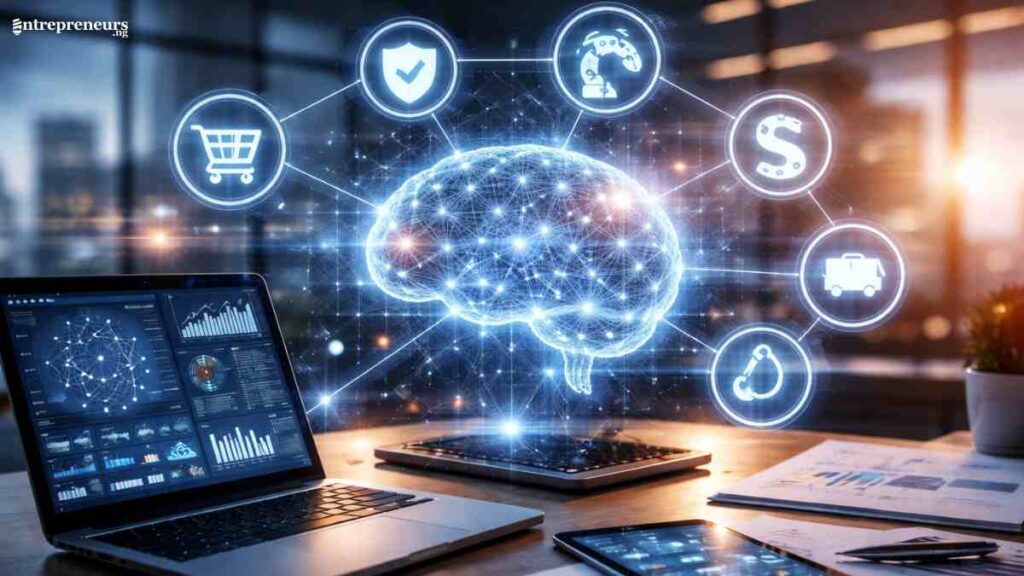
Generative AI is one of the most transformative technologies reshaping how businesses create content, interact with customers, and make data-driven decisions today. Unlike traditional AI, which focuses mainly on analysis and prediction, generative AI excels at creating entirely new material.
Its impact is already evident. According to a McKinsey report, generative AI could add the equivalent of $2.6 to $4.4 trillion annually to the global economy across various industries, including banking, retail, life sciences, and manufacturing.
In this article, we will explore how generative AI works, the different types available, its business impacts, the challenges it presents, and what the future holds.
Key Takeaways
- Generative AI is revolutionising business by automating content, boosting customer service, and enabling smarter decisions.
- Understanding generative AI’s process, from data to deployment, is key to effective integration.
- Generative AI spans text, image, video, audio, and code, driving creativity and efficiency.
- Its business impact extends to marketing, product innovation, customer engagement, efficiency, and strategy.

What is Generative AI?
Generative AI is a branch of artificial intelligence that focuses on creating new content rather than just analysing existing data.
Using advanced models like large language models (LLMs) and generative adversarial networks (GANs), it learns from vast datasets to produce outputs that resemble human creativity. These outputs can include text, images, videos, audio, designs, or even software code.
Unlike traditional AI, which is primarily designed for classification, prediction, or optimisation, generative AI has the unique ability to generate original material that did not exist before. For example, it can draft business reports, design product prototypes, compose music, or even simulate conversations with customers.
Difference Between Traditional AI and Generative AI
Artificial intelligence has been shaping industries for years, but not all AI systems are the same. Traditional AI focuses on analysing data, spotting patterns, and making predictions, while generative AI goes a step further by creating brand-new content.
Understanding this difference helps businesses know when to use predictive tools and when to embrace generative models for innovation and creativity.
| Aspect | Traditional AI | Generative AI |
|---|---|---|
| Purpose | Analyses existing data to classify, predict, or recommend. | Creates entirely new content (text, images, audio, video, code). |
| Key Function | Recognises patterns and makes data-driven decisions. | Generates original material by learning from patterns. |
| Examples | Fraud detection, spam filters, product recommendations. | ChatGPT for text, DALL·E for images, GitHub Copilot for code. |
| Output Type | Predictive or descriptive insights. | Creative, human-like outputs. |
| Use in Business | Optimises operations, improves efficiency, reduces risk. | Drives innovation, automates creativity, enhances engagement. |
Types of Generative AI
Generative AI comes in different forms, each designed to produce a unique kind of output. These types range from text and images to audio, video, and even computer code.
Understanding them helps businesses choose the right tools to boost creativity, automate processes, and solve real-world challenges.
| Type | Description | Business Applications |
|---|---|---|
| Text Generation | Creates written content such as articles, reports, and chat responses using large language models. | Automating emails, writing blogs, and using customer support chatbots. |
| Image Generation | Produces original images, graphics, and designs by learning visual patterns. | Marketing visuals, product design, branding, and advertising. |
| Video Generation | Generates videos or animations based on prompts or datasets. | Marketing campaigns, training videos, personalised ads. |
| Audio Generation | Creates human-like speech, sound effects, or music. | Voice assistants, podcasts, audio ads, background music. |
| Code Generation | Writes and optimises computer code for software development. | Faster app development, debugging, and automating repetitive coding tasks. |
See also: Generative AI and Its Economic Impact – What You Need to Know

How Generative AI Works
Generative AI may seem magical, but at its core, it follows a clear process powered by advanced machine learning techniques.
Unlike traditional AI that classifies or predicts outcomes, generative AI studies patterns in vast amounts of data and uses them to produce entirely new content. Here is a breakdown of how it works:
Step 1: Data Collection and Preprocessing
Every generative AI system starts with data. These models are trained on enormous datasets, which may include text, images, audio, video, or even programming code. The quality and diversity of this data directly influence how well the model performs.
For example, a model like ChatGPT is trained on billions of words from books, articles, and online resources, allowing it to generate language that feels natural and context-aware.
Step 2: Model Architecture
The architecture is the engine that powers generative AI. Large Language Models (LLMs) are built to handle text-based tasks and are skilled at predicting words and structuring human-like sentences.
Generative Adversarial Networks (GANs), on the other hand, rely on two competing neural networks, a generator and a discriminator, that work together to create realistic content such as images or videos.
More recently, diffusion models have emerged as powerful tools for producing high-quality images by gradually transforming random noise into coherent, detailed visuals.
Step 3: Pattern Learning
Once the model has access to data, it begins to identify patterns and relationships. For text, it learns grammar, sentence structure, and context. For images, it understands colour, shape, and texture. In coding, it picks up on syntax and logical sequences.
This stage is what gives generative AI the ability to mimic human creativity while ensuring outputs are contextually accurate.
Step 4: Content Generation
When you give a prompt, the AI taps into what it has learned to generate brand-new material. The result could be a written article, an advertising image, a video explainer, a new song, or a block of computer code.
Importantly, while the AI does not “think” like humans, it recombines learned patterns in innovative ways that appear original and highly useful.
Step 5: Fine-Tuning and Deployment
Finally, businesses often adapt pre-trained models by fine-tuning them with industry-specific or brand-specific data. This ensures the AI not only generates content but also aligns with the company’s tone, values, and professional needs.
Once fine-tuned, the model can be deployed in real-world applications, from marketing campaigns to customer service chatbots, where it provides practical, scalable solutions.
See Also: How Much Energy Does AI Use? The Hidden Energy Toll Behind Smart Tech
Core Technologies of Generative AI
Generative AI is powered by advanced machine learning systems that give it the ability to learn, adapt, and create. At the heart of this technology are specialised models and algorithms that process huge volumes of data and generate outputs that feel both original and human-like.
Three of the most important technologies driving generative AI are Large Language Models (LLMs), Generative Adversarial Networks (GANs), and Diffusion Models.
Each plays a unique role in enabling machines to move beyond prediction and towards true creation.
Large Language Models (LLMs)
Large Language Models are at the centre of text-based generative AI. They are trained on vast collections of written material, from books and articles to online conversations, enabling them to understand context, grammar, and meaning.
By predicting the next word in a sequence, LLMs can generate long passages of coherent text that resemble human writing. This makes them useful for everything from answering customer queries and drafting business emails to producing code and summarising complex documents.
Tools like ChatGPT and Jasper AI are prime examples of LLMs in action, showing how text generation can support productivity and creativity at scale.
Generative Adversarial Networks (GANs)
GANs operate differently by relying on a game-like setup between two neural networks, the generator and the discriminator.
The generator creates outputs, such as an image, while the discriminator checks how authentic the output looks compared to real data. Over time, this back-and-forth process improves the generator’s ability to create highly realistic results.
GANs are widely used in creative industries to design fashion prototypes, generate lifelike portraits, and even restore old photographs. Their strength lies in producing visuals and media that are almost indistinguishable from reality, giving businesses powerful tools for design, advertising, and entertainment.
Diffusion Models
Diffusion models are the newer players in the generative AI space, especially in image creation. They work by taking a noisy, random input and gradually refining it into a detailed, high-quality image.
Unlike GANs, which can sometimes struggle with fine details, diffusion models excel at producing sharp, consistent visuals. Popular platforms such as DALL·E and Stable Diffusion use this technique to turn simple text prompts into imaginative or photorealistic images.
Businesses are already using diffusion models to create marketing visuals, product concepts, and advertising material in a fraction of the time traditional design would take.
See Also: How Much Energy Does AI Use? The Hidden Energy Toll Behind Smart Tech

Business Impacts of Generative AI
Generative AI is no longer just a futuristic concept, it is already reshaping how companies operate, compete, and grow.
From creating personalised marketing campaigns to accelerating product development and improving customer service, this technology offers businesses new ways to innovate while cutting costs.
Its impact spans across industries, boosting efficiency, enhancing creativity, and enabling smarter decision-making at scale.
1. Marketing and Content Creation
One of the most visible impacts of generative AI is in marketing and content creation. Traditionally, businesses spend significant time and resources producing advertising copy, blog articles, product descriptions, and social media posts. With generative AI, much of this work can now be automated, freeing teams to focus on strategy and creativity.
AI-powered tools can generate tailored content for different customer segments in minutes, ensuring that marketing messages resonate more effectively. For instance, an e-commerce brand can use AI to write personalised product descriptions for thousands of items. Beyond text, image-generation tools like DALL·E or Canva AI help marketers design eye-catching visuals without needing a professional designer.
This shift does more than just save time. It makes campaigns more cost-effective and scalable. Businesses can run more targeted and personalised campaigns, increasing customer engagement and conversion rates.
2. Customer Service
Generative AI is revolutionising customer service by making support faster, smarter, and more accessible. With AI-powered chatbots and virtual assistants, businesses can now provide round-the-clock service, answering frequently asked questions instantly and in multiple languages. This ensures that customers no longer wait in long queues or depend solely on human agents for basic enquiries.
For businesses, the benefits go beyond speed. Generative AI tools can analyse customer interactions to identify patterns and suggest personalised solutions, creating a more tailored experience. They also free human agents from routine tasks, allowing them to focus on resolving complex or sensitive issues that require empathy and critical thinking.
Startups and small businesses, in particular, gain a competitive edge by deploying AI-driven support systems at a fraction of the cost of hiring large teams. By combining efficiency with personalisation, generative AI helps companies build stronger relationships with customers while keeping operations lean.
3. Product Development
Generative AI is streamlining product development by enabling businesses to design, test, and refine ideas faster.
Instead of relying on lengthy prototype cycles, companies can now generate multiple design variations in hours, cutting costs and reducing time-to-market.
Industries like fashion, automotive, and consumer electronics already use AI to predict trends and create products that meet customer preferences. For startups, this means being able to innovate quickly without the heavy expense of traditional R&D.
4. Workforce Efficiency
Generative AI enhances workforce efficiency by automating repetitive tasks and supporting employees with smarter tools. From drafting reports and analysing data to creating presentations or writing code, AI reduces time spent on routine work.
This allows teams to focus on higher-value activities like strategy, innovation, and customer engagement.
For small businesses, it means achieving more with fewer resources, while larger organisations benefit from improved productivity across departments.
5. Strategic Decision-Making
Generative AI supports better decision-making by turning complex data into actionable insights. It can simulate scenarios, forecast trends, and highlight risks that might not be obvious to human analysts. This helps leaders make informed choices on everything from market expansion to resource allocation.
For entrepreneurs, it means gaining access to decision-making tools that were once available only to large corporations, levelling the playing field and improving competitiveness.
See also: Best AI Tools for Business According to Business Leaders- 12 Game-Changing Apps

Challenges and Risks of Generative AI
While generative AI offers exciting opportunities, it also brings challenges and risks that businesses must carefully manage.
Understanding these issues is essential for entrepreneurs who want to adopt the technology responsibly and sustainably.
Accuracy and Reliability
One of the biggest concerns with generative AI is accuracy. These models can sometimes produce outputs that are factually incorrect or misleading, a problem often referred to as “hallucination.”
If unchecked, such errors can damage a company’s credibility, especially when used in marketing materials, customer communications, or decision-making.
Intellectual Property and Copyright
Generative AI systems often train on existing content, raising legal and ethical questions about ownership. For instance, an AI-generated image might unintentionally mimic a copyrighted design, leading to disputes.
Businesses need to be mindful of how they use AI-generated content and stay updated on evolving copyright laws.
Bias and Ethical Concerns
AI models learn from the data they are trained on. If that data contains biases, whether cultural, gender-based, or racial, those biases can show up in the outputs.
This creates risks of reinforcing stereotypes or unintentionally offending customers. Ethical guidelines and diverse training data are necessary to reduce these risks.
Security and Misinformation
Generative AI can be misused to create deepfakes, fake news, or fraudulent content, posing risks to businesses and society at large. These threats can damage reputations, mislead customers, or even be exploited for cybercrime.
Companies must invest in safeguards to ensure their use of AI cannot easily be manipulated for harmful purposes.
Regulatory and Compliance Challenges
Governments worldwide are beginning to regulate AI usage, with frameworks like the EU AI Act setting stricter rules.
Businesses must navigate these emerging regulations, ensuring they comply with requirements around transparency, accountability, and data protection. Non-compliance could lead to fines or reputational damage.
Implementation Costs
While AI tools are becoming more accessible, advanced generative AI systems can still be expensive to adopt and integrate.
For startups and small businesses, costs related to software, data, and skilled talent may pose significant barriers. Strategic planning is needed to balance investment with long-term value.
The Future of Generative AI in Business
Generative AI is still in its early stages, yet it is evolving rapidly and shaping the future of work, innovation, and industry growth.
As the technology matures, we can expect it to move beyond simple content creation into more advanced, integrated roles across businesses.
From multimodal AI that combines text, images, and audio, to sector-specific solutions tailored to industries like healthcare or finance, the next wave of generative AI promises to unlock even greater opportunities for entrepreneurs and enterprises.
| Future Trend | What It Means | Opportunities for Business |
|---|---|---|
| Multimodal AI | AI that can understand and generate across multiple formats (text, image, video, and audio simultaneously). | Enables richer customer experiences, more advanced virtual assistants, and seamless cross-media content creation. |
| Industry-Specific AI | Custom generative AI models built for sectors like healthcare, law, finance, or education. | Provides tailored insights, compliance support, and innovation suited to each industry’s needs. |
| Democratisation of AI Tools | AI becomes more affordable and accessible to startups and SMEs. | Levels the playing field by giving small businesses access to powerful tools once limited to large corporations. |
| Integration with Emerging Tech | Generative AI is working alongside Web3, blockchain, and IoT. | Creates new business models, enhances transparency, and supports secure digital ecosystems. |
| Regulation and Ethical AI | Stricter global rules on data use, transparency, and accountability. | Encourages responsible innovation and builds consumer trust in AI-driven solutions. |
How Businesses Can Harness Generative AI
Adopting generative AI does not have to be overwhelming. With the right approach, businesses of all sizes can tap into their potential to save time, reduce costs, and innovate faster.
The key lies in starting small, choosing the right tools, and ensuring ethical, compliant use. Below are practical ways companies can integrate generative AI into their operations.
| Step | What It Involves | Business Benefit |
|---|---|---|
| Start Small | Experiment with accessible tools like ChatGPT for text or Canva AI for visuals. | Quick wins in productivity without large upfront costs. |
| Train Teams | Equip employees with knowledge of how to use AI tools effectively. | Improves adoption, reduces resistance, and maximises efficiency. |
| Customise Models | Fine-tune AI with industry-specific or company-specific data. | Aligns outputs with brand voice, goals, and customer needs. |
| Integrate Ethically | Be transparent about AI use and avoid over-reliance. | Builds customer trust and ensures responsible use. |
| Measure ROI | Track cost savings, efficiency, and engagement improvements. | Ensures AI adoption delivers measurable value to the business. |
Conclusion
Generative AI is reshaping the way businesses create, operate, and compete. While it offers immense opportunities for efficiency, creativity, and growth, it also demands responsible use and awareness of its risks.
Entrepreneurs who embrace this technology strategically, balancing innovation with ethics, will be best positioned to thrive in the future of business.
We want to see you succeed, and that’s why we provide valuable business resources to help you every step of the way.
- Join over 23,000 entrepreneurs by signing up for our newsletter and receiving valuable business insights.
- Register your business today with Entrepreneurs.ng’s Business Registration Services.
- Tell Your Brand Story on Entrepreneurs.ng, let’s showcase your brand to our global audience.
- Need help with your marketing strategy? Get a Comprehensive Marketing and Sales Plan here.
- Sign up for our Entrepreneurs Success Blueprint Programme to learn how to start and scale your business in just 30 days.
- Book our one-on-one consulting and speak to an expert about structuring and growing your business.
- Visit our shop for business plan templates and other valuable resources to guide you.
- Get our Employee-Employer Super Bundle NDA templates to legally protect your business and workforce.
- Advertise your business to over a million entrepreneurs through our different advertising packages.

Frequently Asked Questions (FAQs)
What is generative AI?
It is a type of artificial intelligence that can create new content, such as text, images, audio, video, or code, based on patterns it has learned from existing data.
How does generative AI work?
It works by analysing large datasets, learning patterns, and producing outputs that mimic human creativity. It uses models like neural networks, transformers, and GANs to generate new content.
What are examples of generative AI?
Examples include ChatGPT for text generation, DALL·E and MidJourney for images, Synthesia for video creation, and GitHub Copilot for code generation.
What are the types of generative AI?
The main types are text generation, image generation, video generation, audio/music generation, and code generation, each serving different business or creative needs.
What is the business impact of generative AI?
Its impact on business includes faster content creation, improved customer service, enhanced product development, smarter marketing, and data-driven decision-making.
What are the challenges of using generative AI in business?
Challenges include data bias, ethical concerns, quality control, high implementation costs, security risks, and intellectual property issues.
How does generative AI assist in marketing?
It creates targeted copy, visuals, and videos, analyses customer preferences, and predicts trends, helping businesses improve campaign effectiveness and ROI.
How does generative AI impact business operations?
It automates repetitive tasks, enhances creative output, optimises workflows, and improves efficiency across departments such as marketing, HR, and R&D.
Is generative AI suitable for small businesses?
Yes. With the right tools and planning, small businesses can leverage it to save time, reduce costs, and enhance creativity, though initial investment may be a consideration.
Why is understanding how generative AI works important for businesses?
Knowing how it works helps organisations integrate it effectively, anticipate challenges, and maximise its business impacts for long-term success.