AI research tools have fundamentally changed how entrepreneurs and knowledge workers gather and use information. Tasks that once took days of manual searching and analysis can now be completed in hours, without losing depth.
According to a report by Verbit, generative AI can increase knowledge-worker productivity by up to 40%, largely by speeding up research and synthesis.
Today’s AI research tools go beyond search. They scan vast parts of the web, analyse academic studies, assess sources, and turn scattered data into structured insight, making them indispensable for market research, deep analysis, and informed decision-making.
Key Takeaways
- AI research tools dramatically cut research time by automating discovery, analysis and synthesis without compromising depth.
- Not all tools serve the same purpose, so choosing the right one depends on whether you need web insight, academic depth or structured reports.
- Credibility now matters more than speed, making citation-aware and evidence-based AI tools essential for serious research.
- Used strategically, AI research tools give entrepreneurs a decision-making edge by turning information overload into clear, actionable insight.
The 15 Best AI Research Tools to Use Right Now
The best AI research tools act as intelligent AI research assistants, helping you find, analyse and synthesise information faster and with more accuracy.
Some platforms serve as advanced AI research software for structured insights, while others function as AI tools for data analysis, transforming complex information into clear conclusions.
Below, we highlight the best AI research tools and where each one fits in a modern research workflow.
1. ChatGPT Deep Research (OpenAI)
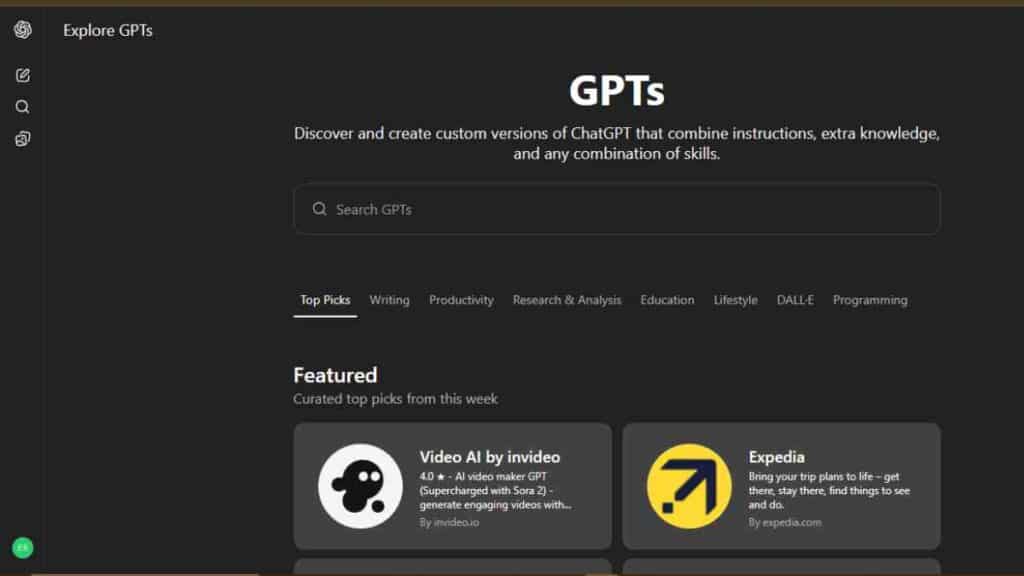
ChatGPT Deep Research is one of the most advanced AI-powered research tools available today, designed to handle complex, multi-layered research tasks from start to finish.
Unlike standard AI chat tools, it works as a true deep research AI tool, autonomously planning research steps, browsing the web, evaluating sources, and producing well-structured, cited reports.
For entrepreneurs, analysts and writers who need depth rather than surface-level answers, it functions as a competent AI research assistant.
Key Features
- Autonomous web research across multiple sources
- Structured, long-form research reports with clear citations
- Adaptive research paths that refine queries as new insights emerge
- Natural language reasoning for explanation and context
- Ability to synthesise large volumes of information quickly
What Makes It Stand Out
ChatGPT Deep Research distinguishes itself through autonomy and depth. Unlike many AI research software tools that rely on constant prompting, it can take a broad research objective and execute it independently.
This makes it one of the most effective deep research AI tools for turning scattered information into coherent, decision-ready insight.
Pricing
Available through OpenAI’s paid ChatGPT plans, including Plus and higher tiers. Pricing is subscription-based, making it practical for users who conduct frequent or ongoing research.
Limitations
While powerful, the tool depends on publicly available sources and may miss proprietary or highly niche data.
Citations should be reviewed for critical decisions, and for highly specialised academic work, dedicated academic AI research tools may offer greater precision.
2. Perplexity AI
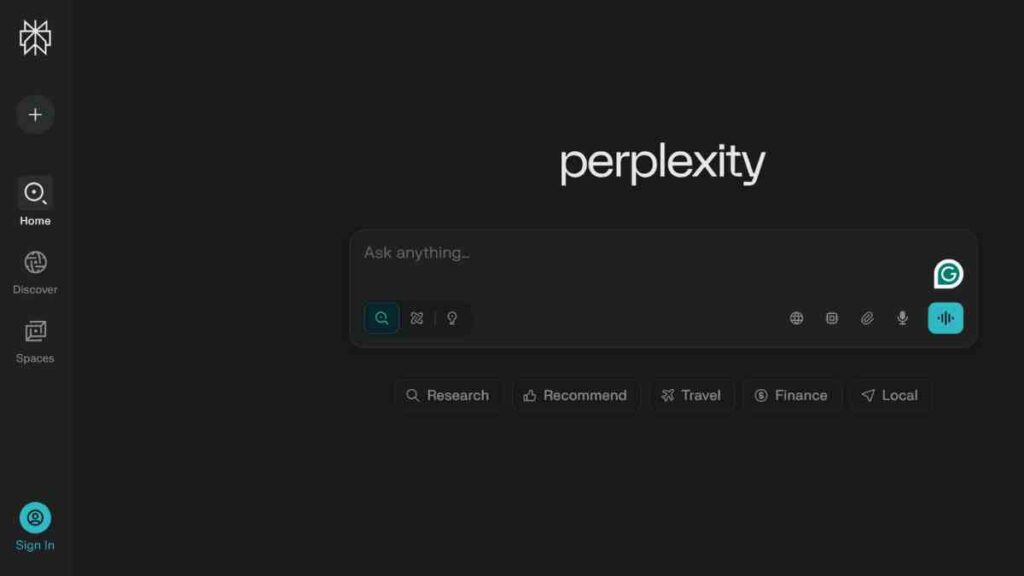
Perplexity AI is a fast, citation-first AI research assistant built for real-time web research.
It combines conversational search with live internet access, making it one of the most practical AI-powered research tools for users who want accurate answers backed by sources, not guesses.
It is especially effective for rapid market scans, trend analysis and fact-checking.
Key Features
- Real-time web search with clearly cited sources
- Concise research summaries with follow-up questioning
- Deep-dive mode for broader topic exploration
- Source previews to verify credibility quickly
- Multi-source comparison for balanced insights
What Makes It Stand Out
Perplexity’s biggest strength is trust. Unlike many tools that summarise without transparency, it shows exactly where information comes from.
This makes it one of the best AI research tools for journalists, founders and analysts who value speed and credibility.
As a deep research AI tool, it excels at converting scattered web content into a quick, reliable understanding.
Pricing
Perplexity offers a free plan with limited usage and a paid Pro version that unlocks advanced research modes, faster responses and access to more powerful AI models.
Pricing is subscription-based and competitive compared to similar AI research software.
Limitations
While excellent for web-based research, Perplexity is less suited to heavy academic AI research tools use cases, such as peer-reviewed literature analysis.
It also focuses more on summarisation than deep interpretation, making it less ideal for long-form synthesis or complex data analysis tasks.
3. Google Gemini Deep Research
Google Gemini Deep Research is a powerful addition to Google’s AI ecosystem, built to handle complex, exploratory research tasks at scale.
It functions as a sophisticated deep research AI tool, combining Google’s vast search infrastructure with advanced reasoning to deliver structured insights, summaries and visual outputs.
For users already embedded in Google’s workspace, it works seamlessly as an intelligent AI research assistant.
Key Features
- Large-scale web research powered by Google Search
- Structured research plans and step-by-step exploration
- AI-generated summaries with supporting sources
- Interactive charts, diagrams and visual explanations
- Integration with Google’s productivity tools
What Makes It Stand Out
What sets Gemini apart is its ability to pair depth with visual clarity.
Unlike many AI-powered research tools that rely purely on text, Gemini can present findings through charts and diagrams, making complex ideas easier to understand.
Its tight integration with Google’s data ecosystem places it among the best AI research tools for users who want both breadth and clarity in their research workflow.
Pricing
Gemini Deep Research is available through Google’s premium AI plans. Access is typically bundled within paid subscriptions, with pricing varying based on region and plan tier.
Limitations
Despite its strengths, Gemini can feel less transparent than some citation-first AI research software when it comes to source depth.
It also prioritises web-based content, making it less suitable than dedicated academic AI research tools for highly specialised scholarly research or advanced data analysis tasks.
4. NotebookLM (Google)
NotebookLM is a research-focused AI research assistant designed to help users think through complex information, not just find it.
Built by Google, it allows you to upload documents, links and notes, then uses AI to analyse, connect and summarise them.
Rather than replacing your thinking, it works alongside you, making it a strong AI-powered research tool for deep understanding and sense-making.
Key Features
- Upload and analyse PDFs, documents and web sources
- AI-generated summaries grounded strictly in your sources
- Question-and-answer interaction based on uploaded material
- Automated deep research across multiple web pages
- Clear source attribution to reduce hallucinations
What Makes It Stand Out
NotebookLM’s biggest advantage is control. Unlike many deep research AI tools that pull freely from the open web, it limits responses to the sources you provide or approve.
This makes it one of the most reliable AI research software options for researchers, strategists and writers who want accuracy over speculation.
It also performs well as a lightweight academic AI research tool when working with papers and reports.
Pricing
NotebookLM is currently available at no cost, with advanced features increasingly bundled into Google’s premium AI offerings as the product evolves.
Limitations
NotebookLM is less effective for real-time discovery compared to search-driven AI-powered research tools like Perplexity.
It also lacks advanced capabilities as an AI tool for data analysis, making it better suited to qualitative research and synthesis rather than numerical or statistical work.
5. Elicit
Elicit is one of the most respected academic AI research tools, built specifically for evidence-based research and literature discovery.
It acts as a specialised AI research assistant for researchers who need to find, compare and extract insights from scientific papers without manually reading hundreds of abstracts.
For serious knowledge work, it stands out as focused, disciplined AI research software.
Key Features
- AI-powered search across millions of academic papers
- Automated literature reviews and evidence extraction
- Paper comparison tables for faster insight
- Key finding summaries grounded in source material
- Question-driven research workflows
What Makes It Stand Out
Elicit’s strength lies in rigour. Unlike many AI-powered research tools built for the open web, it is designed around peer-reviewed research and evidence synthesis.
This makes it one of the best AI research tools for academic, policy or data-backed business research.
It is particularly effective as a deep research AI tool when validating claims or building arguments rooted in science.
Pricing
Elicit offers a free tier with limited usage, alongside paid plans that unlock higher query limits and advanced features. Subscription pricing is structured to suit both independent researchers and teams.
Limitations
Elicit is not designed for general web exploration or breaking news. It also does not function as a full AI tool for data analysis, focusing instead on qualitative evidence rather than raw datasets.
For broader market or trend research, it works best when paired with other AI-powered research tools.

6. Semantic Scholar
Semantic Scholar is a widely used academic AI research tool developed to help researchers discover and understand scientific literature faster.
Backed by AI, it goes beyond keyword matching to surface relevant papers, highlight influential studies, and summarise key findings.
For anyone doing evidence-led work, it serves as a dependable AI research assistant rather than a generic search engine.
Key Features
- AI-powered search across millions of peer-reviewed papers
- Automatic paper summaries and key concept extraction
- Citation analysis to identify influential research
- Author and topic relevance scoring
- Free access with no subscription barrier
What Makes It Stand Out
Semantic Scholar’s strength is credibility at scale. It applies machine learning to rank papers by relevance and influence, helping users avoid low-impact or misleading studies.
This makes it one of the best AI research tools for academic and technical deep dives.
While not a traditional AI tool for data analysis, it excels as an AI research software for understanding complex research landscapes fast.
Pricing
Semantic Scholar is completely free to use, making it one of the most accessible AI-powered research tools for students, entrepreneurs and professionals alike.
Limitations
The platform focuses strictly on scholarly literature, so it is not suitable for general web or market research.
It also lacks advanced synthesis and report-generation features found in some deep research AI tools, meaning users still need to interpret and structure insights manually.
7. ResearchRabbit
ResearchRabbit is a discovery-focused AI research assistant built to help users explore academic literature through relationships, not just search results.
Instead of presenting isolated papers, it shows how studies, authors and ideas connect over time. This makes it a valuable AI-powered research tool for understanding research trends and emerging themes.
Key Features
- Visual citation and paper relationship maps
- Author and topic tracking for ongoing research
- Personalised recommendations based on saved papers
- Timeline views to spot research evolution
- Collaboration features for shared libraries
What Makes It Stand Out
ResearchRabbit excels at context. While many academic AI research tools focus on retrieval, this platform focuses on discovery.
Its visual approach makes it one of the most intuitive deep research AI tools for spotting gaps, patterns and opportunities in existing literature.
It works particularly well alongside other AI research software used for synthesis and writing.
Pricing
ResearchRabbit is currently free to use, with optional institutional support and future premium features under development.
Limitations
ResearchRabbit does not generate summaries or structured reports, limiting its usefulness as a standalone AI-powered research tool.
It also lacks capabilities as an AI tool for data analysis, meaning users must rely on other platforms for numerical or statistical insight.
8. Scite
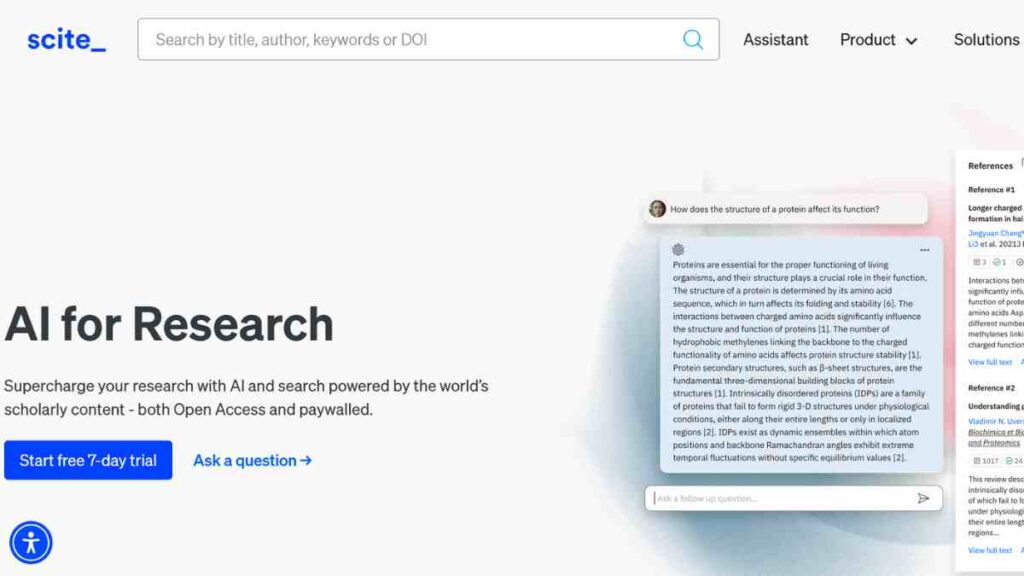
Scite is a credibility-focused AI research assistant designed to show how research is cited, not just how often.
Instead of treating all citations equally, it classifies them based on whether a paper supports, contrasts or merely mentions another study.
This makes Scite a highly practical AI-powered research tool for evaluating evidence quality rather than volume.
Key Features
- Smart citation classification (supporting, contrasting, mentioning)
- Contextual citation excerpts for deeper understanding
- Research dashboards for tracking evidence strength
- Reference checking for manuscripts and reports
- Integration with academic databases
What Makes It Stand Out
Scite’s unique value lies in nuance. Many academic AI research tools stop at citation counts, but Scite goes further by analysing citation intent.
This places it among the best AI research tools for researchers, analysts and founders who need defensible, evidence-backed insight.
Pricing
Scite offers a limited free version, with paid plans available for individuals, institutions and teams. Pricing is subscription-based and scales with feature access.
Limitations
Scite is not built for general web discovery or exploratory market research.
It also does not function as an AI tool for data analysis, focusing instead on literature credibility.
For broader synthesis or deep reporting, it works best alongside other deep research AI tools.
See Also: Scite AI Review- I Used It For Research, Is It Really the Best AI Tool for Smart Citations?
9. Consensus
Consensus is an evidence-first AI research assistant built to answer questions using peer-reviewed science rather than opinion or web noise.
It searches millions of academic papers and surfaces clear, research-backed answers, making it a highly trusted AI-powered research tool for fact-driven decision-making.
Key Features
- AI search across a vast database of peer-reviewed studies
- Plain-language summaries of scientific findings
- Evidence strength indicators to show research consensus
- Direct links to original academic sources
- Yes/No and nuanced answer formats for clarity
What Makes It Stand Out
Consensus focuses on what the science actually says. While many academic AI research tools retrieve papers, Consensus synthesises findings across studies to highlight agreement or disagreement.
This makes it one of the best AI research tools for validating claims, testing assumptions and avoiding cherry-picked evidence.
It works particularly well as a deep research AI tool for entrepreneurs and analysts working in data-sensitive fields.
Pricing
Consensus offers a free tier with limited queries, alongside paid subscription plans that unlock deeper access, faster responses and advanced filtering options.
Limitations
Consensus is limited to academic research and does not support general web exploration.
It also lacks features as an AI tool for data analysis, focusing on qualitative evidence rather than raw datasets or modelling. For broader research workflows, it pairs best with other AI research software.
10. Connected Papers
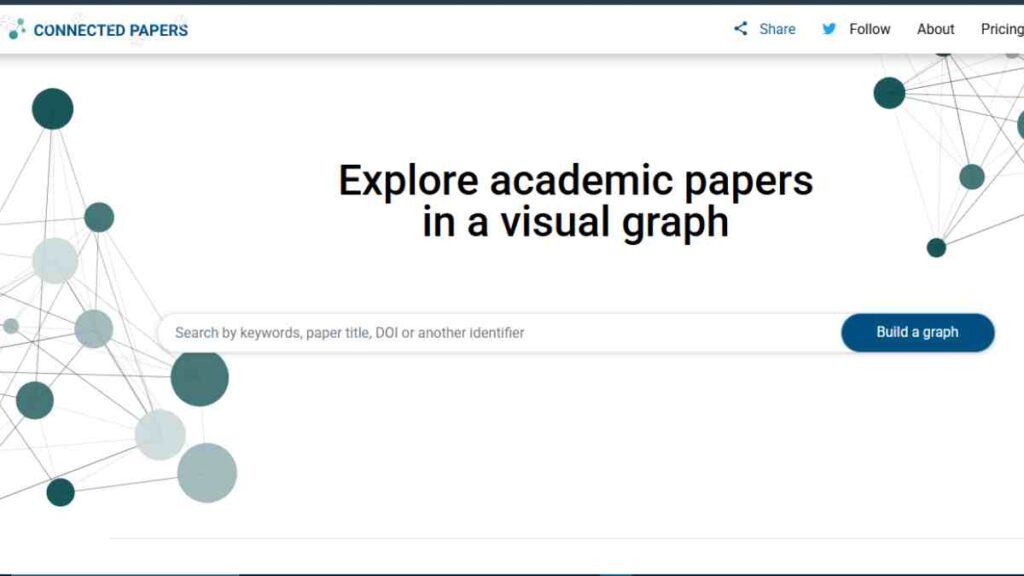
Connected Papers is a visual-first AI research assistant built to help researchers understand how studies relate to one another.
Instead of relying on keyword searches, it creates interactive graphs that show the most relevant papers surrounding a topic. This makes it a valuable AI-powered research tool for quickly grasping research landscapes.
Key Features
- Visual graphs showing relationships between research papers
- Identification of prior and derivative works
- Contextual paper discovery beyond keyword matching
- Simple, intuitive interface for exploration
- Direct access to source papers
What Makes It Stand Out
Connected Papers shines in exploration. As a deep research AI tool, it helps users see the bigger picture, how ideas evolve, where consensus forms, and where gaps exist.
It is one of the best AI research tools for early-stage research, literature mapping and topic familiarisation, especially when paired with more analytical AI research software.
Pricing
Connected Papers offers free access with usage limits, alongside paid plans that unlock higher graph generation and extended exploration features.
Limitations
The tool does not summarise or analyse papers, limiting its role as a standalone AI research assistant.
It also lacks capabilities as an AI tool for data analysis, making it best suited for discovery rather than synthesis or interpretation.

11. SciSpace (formerly Typeset.io)
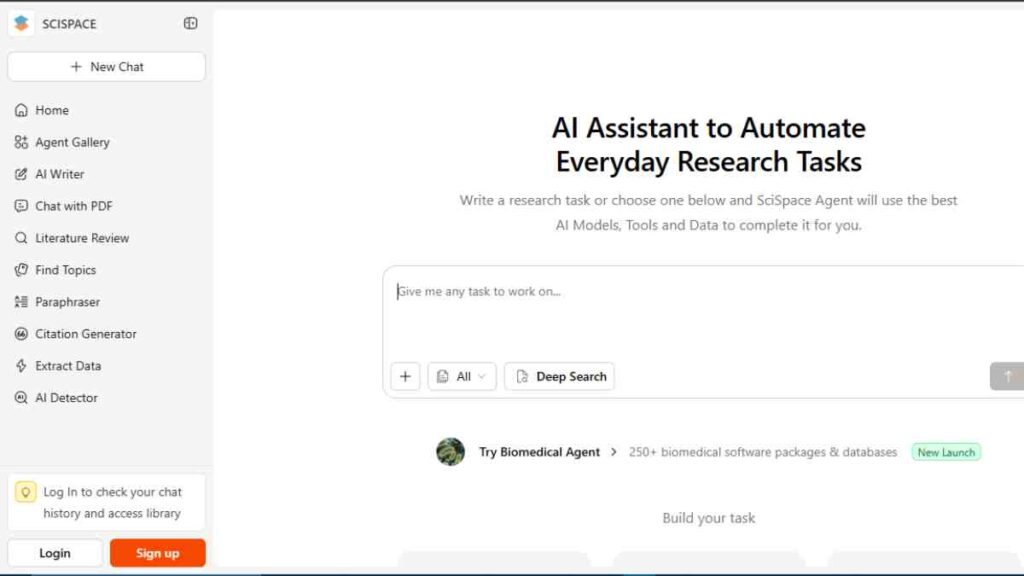
SciSpace is a document-focused AI research assistant designed to help users read, understand and extract insights from academic papers faster.
Instead of searching broadly, it works directly with research documents, making it a practical AI-powered research tool for anyone overwhelmed by dense PDFs and technical language.
Key Features
- AI-powered explanations of research papers in plain language
- PDF interaction with highlighted sections and annotations
- Question-and-answer chat for uploaded academic documents
- Automated summaries of complex studies
- Reference navigation and context-aware explanations
What Makes It Stand Out
SciSpace stands out for accessibility. It removes the intimidation factor from academic reading by breaking down complex ideas clearly.
Among other academic AI research tools, it is one of the most user-friendly, making it ideal for entrepreneurs, students and professionals who need insight without academic overload.
As an AI research software, it bridges the gap between expert knowledge and practical understanding.
Pricing
SciSpace offers a free plan with limited features, alongside paid subscriptions that unlock advanced document interaction, higher usage limits and premium AI models.
Limitations
SciSpace is not designed for large-scale discovery or trend analysis.
It also lacks advanced capabilities as an AI tool for data analysis, focusing instead on interpretation and explanation rather than numerical modelling or dataset exploration.
12. Litmaps
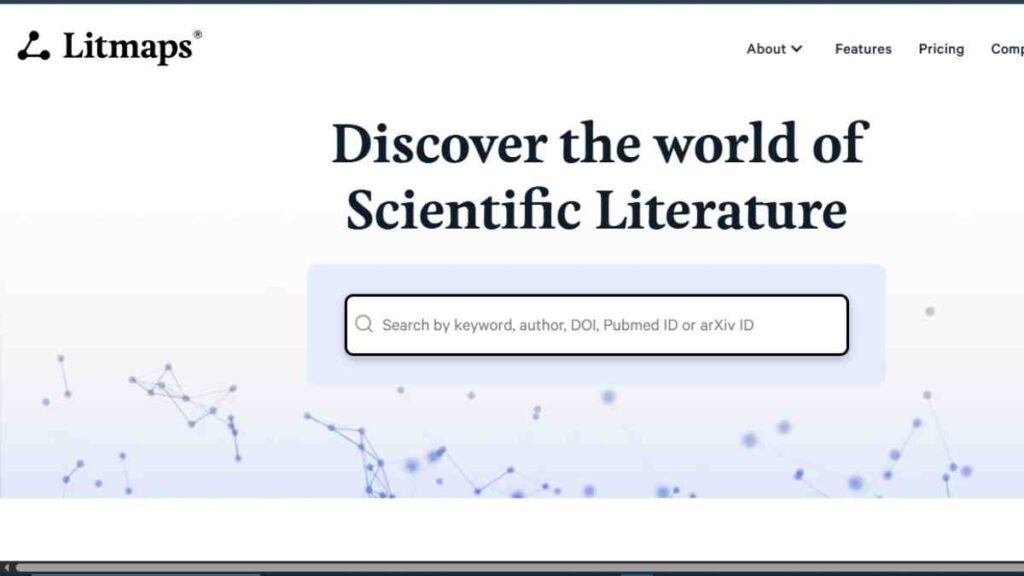
Litmap is a discovery-driven AI research assistant built to help researchers track how ideas evolve.
It focuses on mapping citation networks and surfacing related studies, making it a strong AI-powered research tool for identifying influential papers and emerging research trends.
Key Features
- Interactive citation maps showing research connections
- Forward and backward citation tracking
- Alerts for newly published, relevant studies
- Visual trend analysis across research topics
- Easy integration into existing literature workflows
What Makes It Stand Out
Litmap’s strength lies in continuity. Unlike many academic AI research tools that stop at discovery, it helps users stay current as new research emerges.
As a deep research AI tool, it is especially valuable for long-term projects, systematic reviews and ongoing industry or academic monitoring. It complements other AI research software focused on synthesis and reporting.
Pricing
Litmap offers a free tier with basic features, alongside paid subscription plans that unlock advanced mapping, alerts and expanded usage.
Limitations
Litmap does not summarise or interpret research findings, limiting its role as a standalone AI research assistant.
It also lacks functionality as an AI tool for data analysis, making it best used alongside other AI-powered research tools for deeper insight and synthesis.
13. Inciteful
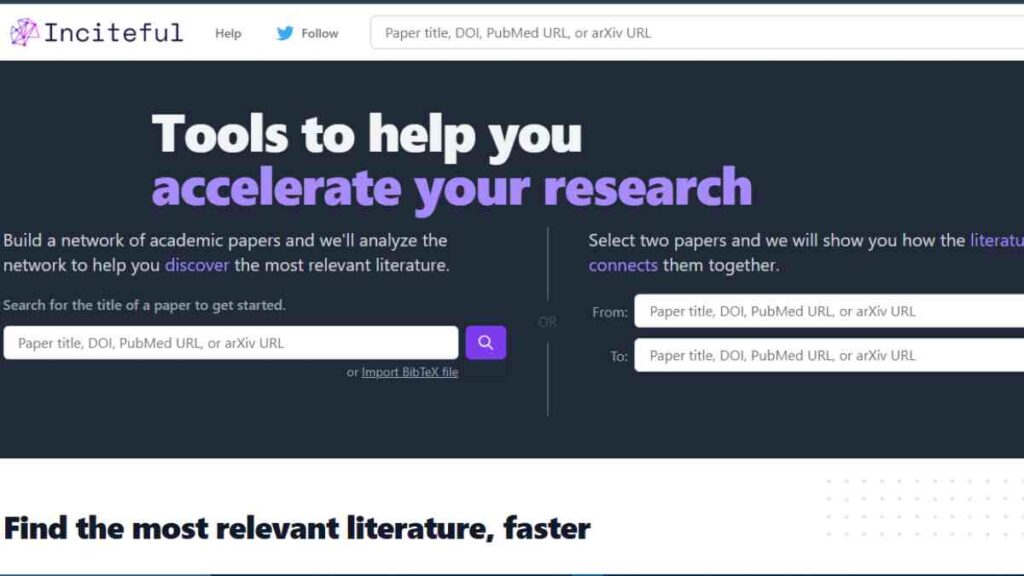
Inciteful is a relationship-driven AI research assistant designed to reveal how research papers influence and connect with one another.
Rather than focusing on surface-level discovery, it analyses citation networks to uncover foundational studies and emerging ideas.
This makes it a focused AI-powered research tool for researchers who want depth, context and intellectual lineage.
Key Features
- Citation network analysis to reveal influential papers
- Discovery of related and derivative research
- Visual relationship mapping between studies
- Topic expansion beyond initial seed papers
- Simple interface for rapid exploration
What Makes It Stand Out
Inciteful’s value lies in intellectual clarity.
Among academic AI research tools, it excels at showing why a paper matters, not just that it exists.
As a deep research AI tool, it helps users trace ideas back to their roots and forward to current thinking.
Pricing
Inciteful is free to use, which makes it an accessible piece of AI research software for students, entrepreneurs and independent researchers.
Limitations
Inciteful does not summarise content or generate insights, limiting its role as a standalone AI research assistant.
It also lacks functionality as an AI tool for data analysis, meaning it is best paired with other AI-powered research tools for interpretation and synthesis.
14. AnswerThis AI Research Assistant
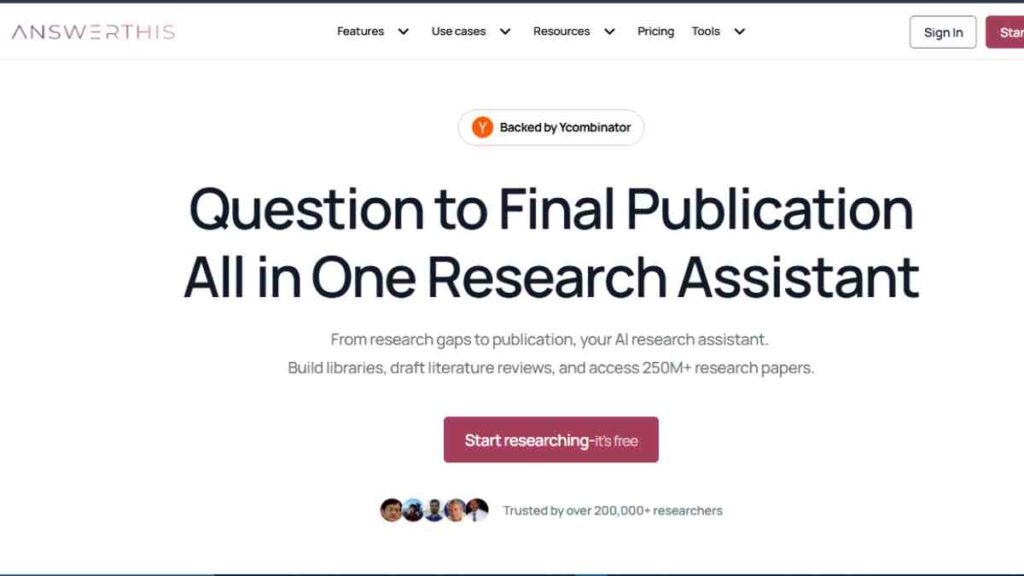
AnswerThis is an end-to-end AI research assistant built for serious, long-form and academic-style research.
It supports the full research lifecycle, from discovering relevant papers to extracting insights and drafting structured outputs.
As an AI research software, it is designed for users who need depth, organisation and evidence rather than quick summaries.
Key Features
- Access to hundreds of millions of academic research outputs
- AI-assisted literature discovery and filtering
- Automated insight extraction from research papers
- Structured support for literature reviews and reports
- Centralised research library for long-term projects
What Makes It Stand Out
AnswerThis stands out for completeness. While many AI-powered research tools focus on a single task, this platform covers discovery, analysis and synthesis in one environment.
It is a particularly strong academic AI research tool for users conducting systematic reviews or building evidence-heavy arguments.
It reduces fragmentation by keeping the entire research process in one place.
Pricing
AnswerThis offers limited free access, with paid subscription plans available for individuals and institutions.
Pricing scales based on feature access and research volume.
Limitations
AnswerThis is less effective for real-time web research or fast-moving topics.
It also focuses more on qualitative synthesis than functioning as an AI tool for data analysis, meaning numerical modelling and dataset exploration require additional tools.
15. STORM
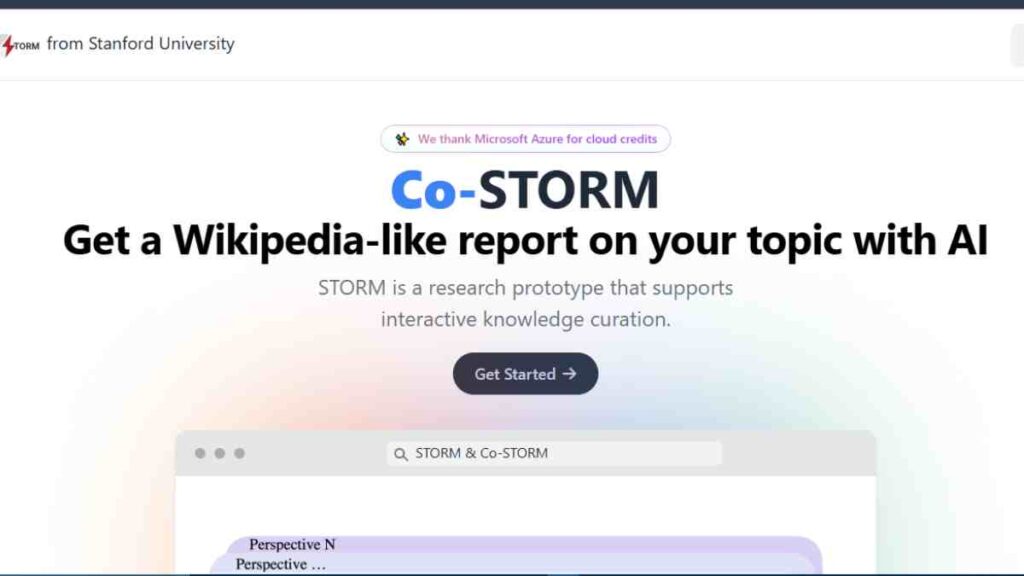
STORM is an open-source deep research AI tool designed to automate the creation of structured, citation-backed articles from web sources.
It operates as a task-oriented AI research assistant, retrieving information, organising arguments, and generating long-form content that mirrors human research workflows.
For writers and analysts, it functions as specialised AI research software rather than a general chatbot.
Key Features
- Automated web retrieval and source evaluation
- Structured outlining and section-by-section article generation
- Built-in citation tracking for transparency
- Multi-step research planning and execution
- Open-source framework for customisation
What Makes It Stand Out
STORM’s standout strength is structure. Unlike many AI-powered research tools that prioritise speed, STORM focuses on logical flow, argument coherence and traceable sourcing.
This makes it one of the best AI research tools for long-form, evidence-based writing.
As a deep research AI tool, it is particularly useful for users who want control over how research is gathered, organised and presented.
Pricing
STORM is free to use as an open-source project. However, users may incur costs related to hosting, model access or API usage depending on how they deploy the system.
Limitations
STORM requires technical setup and is not beginner-friendly.
It also lacks built-in capabilities as an AI tool for data analysis, focusing instead on research synthesis and writing.
For non-technical users, fully managed AI research assistants may offer a smoother experience.

How to Choose the Right AI Research Tool
Choosing the right AI research tool is less about chasing features and more about understanding what kind of thinking you need help with.
Some AI research assistants are built for fast web discovery, others for academic rigour, and a few excel at deep synthesis and long-form insight.
The most effective choice depends on your goal, speed, depth, credibility, and ongoing research management. Use the guide below to match your research needs with the right category of AI-powered research tools.
| Your Research Goal | Best Tool Type | Why It Works | Examples |
|---|---|---|---|
| Fast, credible web answers | AI research assistants | Provide real-time, cited summaries from multiple sources | Perplexity AI, ChatGPT Deep Research |
| In-depth, multi-step research | Deep research AI tools | Autonomously plan, search and synthesise complex topics | ChatGPT Deep Research, STORM |
| Academic or evidence-based research | Academic AI research tools | Focus on peer-reviewed literature and citation quality | Elicit, Semantic Scholar, Consensus |
| Understanding research relationships | Discovery & mapping tools | Visualise how papers, ideas and authors connect | ResearchRabbit, Connected Papers, Litmaps |
| Reading and interpreting papers | Document-based AI research software | Explain dense research in plain language | SciSpace, NotebookLM |
| Evaluating citation strength | Credibility-focused AI tools | Show whether studies support or contradict claims | Scite |
| Long-term research projects | End-to-end AI research software | Manage discovery, synthesis and libraries in one place | AnswerThis |
| Data-heavy or analytical work | AI tools for data analysis | Extract meaning from complex datasets and studies | Gemini Deep Research (limited), paired tools |
Bottom line: the best AI research tools are often used together. Start with a fast AI research assistant for orientation, move to deep research AI tools for synthesis, and rely on academic AI research tools when credibility and evidence matter most.
Conclusion
AI research tools have moved from being helpful extras to essential decision-making assets.
When used deliberately, the right combination of AI research assistants can cut through noise, improve judgement and save valuable time.
We want to see you succeed, and that’s why we provide valuable business resources to help you every step of the way.
- Join over 23,000 entrepreneurs by signing up for our newsletter and receiving valuable business insights.
- Register your business today with Entrepreneurs.ng’s Business Registration Services.
- Tell Your Brand Story on Entrepreneurs.ng, let’s showcase your brand to our global audience.
- Need help with your marketing strategy? Get a Comprehensive Marketing and Sales Plan here.
- Sign up for our Entrepreneurs Success Blueprint Programme to learn how to start and scale your business in just 30 days.
- Book our one-on-one consulting and speak to an expert about structuring and growing your business.
- Visit our shop for business plan templates and other valuable resources to guide you.
- Get our Employee-Employer Super Bundle NDA templates to legally protect your business and workforce.
- Advertise your business to over a million entrepreneurs through our different advertising packages.

Frequently Asked Questions (FAQs)
What are AI research tools?
AI research tools are software platforms that use artificial intelligence to help users find, analyse, synthesise and interpret information from web and academic sources faster and more accurately.
How are AI research assistants different from search engines?
Unlike traditional search engines, AI research assistants summarise information, compare sources, highlight patterns and often provide citations, saving users from manually reviewing dozens of links.
Are AI research tools reliable for serious research?
Yes, when used correctly. Tools that cite sources and rely on peer-reviewed literature, such as academic AI research tools, are especially reliable. However, critical findings should always be verified.
Which AI research tools are best for academic work?
Academic-focused platforms like Elicit, Semantic Scholar, Consensus and Scite are among the best AI research tools for evidence-based and scholarly research.
Can AI research software replace human researchers?
No. AI research software enhances speed and efficiency but does not replace human judgement, context awareness or critical thinking. It works best as a support tool.
Are free AI-powered research tools good enough?
Many free tools offer strong capabilities for basic research. However, paid versions often unlock deeper analysis, higher limits and advanced features needed for professional or long-term work.
What is the best way to use multiple AI research tools together?
Start with a fast AI research assistant for orientation, use deep research AI tools for synthesis, and rely on academic AI research tools when credibility and evidence are essential.