

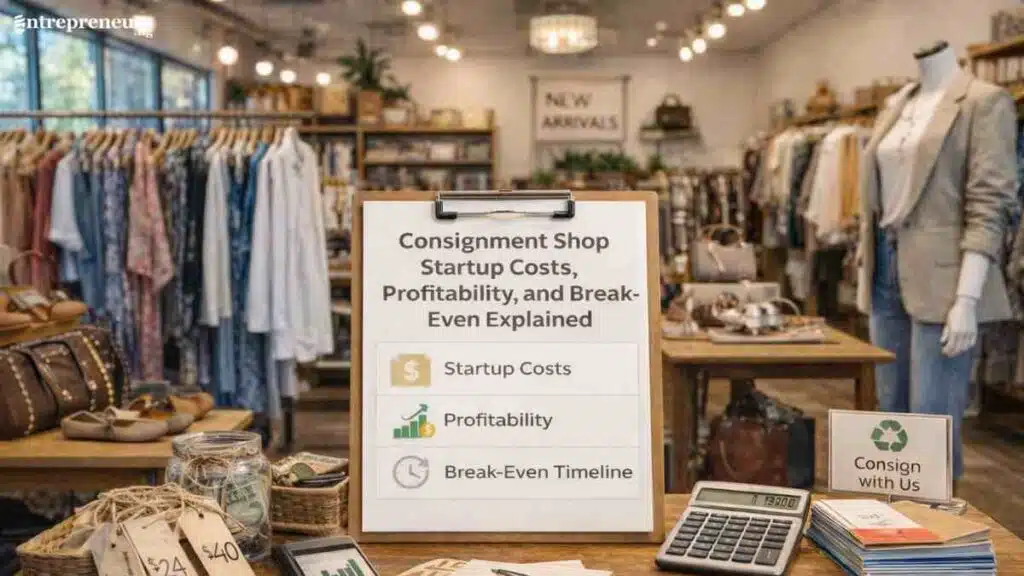
Starting a consignment shop is an exciting way to build a retail business without buying large amounts of inventory upfront.
According to Technavio, the global secondhand apparel market is projected to grow by over $212 billion between 2025 and 2029, driven by rising demand for resale and sustainable fashion .
This guide shows you how consignment shops work and how to start one, covering the essentials from costs to contracts.
Key Takeaways
- A profitable consignment shop depends on clear systems, not just good inventory or foot traffic.
- Your consignment split, pricing rules, and consignor contract will determine trust, margins, and long-term growth.
- Understanding startup costs, unit economics, and inventory flow is essential before you open your doors.
- The shops that scale successfully treat consignment as a structured business model, not a casual resale hustle.

What Is a Consignment Shop and How Does It Work?
A consignment shop is a retail business that sells goods on behalf of individual owners called consignors and pays them only after each item is sold.
The shop does not buy inventory upfront. Instead, it earns a commission on every successful sale, making it a lower-risk entry into retail when managed properly.
To make the process clearer, here is how a typical consignment shop operates from start to finish.
How a Consignment Shop Works Step by Step
| Stage | What Happens |
|---|---|
| Item Intake | Consignors bring in items that meet the shop’s quality, brand, and condition standards. |
| Consignor Contract | Both parties agree on pricing, sales split, selling period, and payout terms. |
| Pricing & Tagging | Items are priced, tagged, and entered into an inventory system. |
| Merchandising & Sales | The shop displays and markets items in-store and/or online. |
| Sale & Commission | When an item sells, the shop keeps its commission percentage. |
| Consignor Payout | The consignor receives their agreed share after the sale. |
| Unsold Items | Items are returned, discounted, or donated based on the contract. |
This structured flow is what separates profitable consignment shops from chaotic ones.
When each stage is clearly defined and supported by proper systems, consignment becomes a scalable and sustainable business model rather than a messy resale operation.
Consignment vs Thrift vs Resale: What is the Difference?
Secondhand retail is often grouped under one label, but consignment, thrift, and resale operate on very different business models.
Understanding how each works is critical when deciding which model fits your goals, capital, and risk tolerance, especially if you are planning to start a consignment shop.
Key Differences at a Glance
| Category | Consignment Shop | Thrift Store | Resale Store |
|---|---|---|---|
| Inventory Ownership | Remains with the consignor until the item sells | Store owns inventory outright through donations | Store owns inventory after purchasing it |
| Upfront Capital Required | Low – no inventory purchases | Very low – stock is donated | High – cash needed to buy inventory |
| Payment Timing | Consignors are paid only after a sale | No supplier payments | Sellers are paid immediately |
| Revenue Structure | Commission-based (e.g. 60/40 or 50/50 split) | 100% of sales revenue kept | 100% of sales revenue kept |
| Cash Flow Pattern | Predictable but delayed | Immediate and predictable | Immediate but cash-intensive |
| Inventory Risk | Low inventory risk, higher operational complexity | Minimal risk but inconsistent quality | High risk of unsold or slow-moving stock |
| Pricing Control | Shared with consignor and limited by agreements | Fully controlled by store | Fully controlled by store |
| Quality & Curation | Curated, often mid-to-high quality | Unpredictable and donation-driven | Highly curated and trend-led |
| Operational Complexity | High – requires tracking items, owners, and payouts | Low – simple intake and pricing | Medium – sourcing, buying, and pricing |
| Scalability Challenges | Systems, inventory tracking, payout management | Donation supply and pricing efficiency | Capital constraints and inventory turnover |
| Brand Positioning | Boutique, sustainable, community-focused | Charity or bargain-focused | Fashion-forward, trend-driven |
| Typical Categories | Fashion, luxury, baby items, furniture | Clothing, household goods | Vintage, sneakers, streetwear |
In simple terms, consignment sits between thrift and resale. It offers lower upfront costs than resale while allowing more control and curation than thrift.
That balance is why many entrepreneurs choose the consignment model when they want to minimise risk without sacrificing brand positioning or margins.

How to Start a Consignment Shop Step-by-Step
Starting a consignment shop is not just about finding a space and filling racks, but about building a system that makes selling, tracking, and paying consignors simple and profitable.
If you want to start a consignment shop that lasts, you need a clear plan for your niche, your intake standards, your pricing rules, and the processes that keep inventory moving and payouts accurate.
This step-by-step guide walks you through exactly how to start, from setting up your consignor contract to mapping your consignment shop startup costs and creating a practical consignment shop business plan.
| Step | Stage | What You Do | Output |
|---|---|---|---|
| 1 | Choose your niche | Pick a category (e.g., women’s fashion, kids, luxury) and define your ideal buyer | Clear positioning and target market |
| 2 | Validate demand | Research local competitors, test with pop-ups or online drops, and confirm pricing appetite | Proof the concept can sell |
| 3 | Decide your model | In-store, online, or hybrid; appointment vs walk-in intake; cash vs store credit payouts | Operating model and workflow |
| 4 | Build a consignment shop business plan | Outline offer, marketing, ops, and 12-month projections | Bankable plan + direction |
| 5 | Budget startup costs | Price rent or fit-out, racks, tags, security, POS, branding, launch marketing | Consignment shop startup costs estimate |
| 6 | Register the business | Set up legal structure, bank account, permits (as required locally) | Compliance-ready business |
| 7 | Create your consignor contract | Set split, selling period, markdown rules, payout schedule, unsold policy | Signed terms that prevent disputes |
| 8 | Set intake standards | Define what you accept or reject, condition rules, brand list, and seasonal policy | Consistent quality control |
| 9 | Build your intake-to-payout system | Tagging, item IDs, inventory tracking, statements, payout process | Operational backbone |
| 10 | Price and plan markdowns | Use comps + condition; set a clear 30/60/90-day markdown schedule | Faster sell-through, less dead stock |
| 11 | Set up the shop and merchandising | Layout, “new arrivals” zone, size sorting, lighting, steaming | Store that sells more per visit |
| 12 | Source consignors | Run consignor acquisition campaigns, referral programme, community partnerships | Reliable inventory pipeline |
| 13 | Launch marketing | Google Business Profile, reviews plan, socials, opening event, drop calendar | Buyer traffic + demand |
| 14 | Track weekly KPIs | Sell-through rate, average selling price, margin after payout, processing cost/item, shrink | Data-driven improvements |
| 15 | Scale responsibly | Add e-commerce, refine terms, expand categories, or open a second location | Growth without chaos |
Step 1: Choose Your Consignment Shop Niche
The success of a consignment shop starts with choosing the right niche. Trying to sell everything to everyone usually leads to slow-moving stock, pricing confusion, and weak branding.
A focused niche helps you attract the right consignors, price items confidently, and build a loyal customer base faster.
Begin by deciding what you want to be known for. This could be women’s fashion, children’s clothing, luxury items, furniture, bridal wear, or workwear.
When choosing your niche, consider:
- Buyer demand: Are people actively searching for and buying these items in your area or online?
- Consignor supply: Can you consistently source quality items from individuals?
- Price point: Will the average selling price support your costs and commission split?
- Competition: Are existing shops underserving this category or doing it poorly?
- Operational complexity: Some niches, like luxury or furniture, require more space, authentication, or logistics.
A clear niche makes every other decision easier, from your consignor contract and pricing rules to marketing and merchandising.
Before moving to the next step, you should be able to describe your shop in one simple sentence, for example: “A curated consignment shop for modern women’s workwear” or “A premium children’s clothing consignment boutique.”
Step 2: Validate Demand Before You Commit
Before you invest time or money, you need proof that people will actually buy what you plan to sell. Many consignment shops fail not because the idea is bad, but because demand was assumed, not tested.
Start by studying your local and online market. Look at existing consignment and resale stores in your area, what categories move fast, what price points they focus on, and where customers complain.
Pay close attention to what sells quickly versus what sits on racks for weeks.
Next, test demand in low-risk ways:
- Run a pop-up sale or weekend stall to see what customers buy.
- Post sample items on Instagram, WhatsApp, or Facebook Marketplace and track engagement.
- Ask potential consignors what items they struggle to resell on their own.
- Check “sold” listings online to understand real market prices, not asking prices.
Validation is not about perfection, but about confidence.
Once you see consistent interest at prices that can support your commission split and operating costs, you can move forward knowing your niche has real commercial potential, not just personal appeal.
Step 3: Decide Your Consignment Shop Model
Once demand is validated, the next move is choosing how your consignment shop will operate day to day. This decision affects your costs, workload, cash flow, and how easily the business can scale.
Start by deciding your sales channels. You can run an in-store-only shop, sell entirely online, or use a hybrid model that combines a physical space with social media and e-commerce.
Many successful consignment shops start lean with online or pop-up sales before committing to a full retail location.
Next, define your intake and payout structure:
- Will consignors book appointments or walk in?
- Will you pay in cash, bank transfer, or store credit?
- Will payouts be weekly, bi-weekly, or monthly?
Finally, decide how hands-on you want to be operationally. Appointment-based intake gives you more control and better-quality stock, while walk-ins increase volume but add complexity.
Store credit improves margins, while cash payouts attract more consignors but affect cash flow.
By the end of this step, you should have a clear operating model that matches your budget, capacity, and long-term goals, before spending money on rent, systems, or marketing.
Step 4: Create a Consignment Shop Business Plan
A strong consignment shop business plan keeps your operations focused and your finances realistic.
It doesn’t need to be long, but it must clearly explain how the business operates, how it generates revenue, and how it scales.
Core Elements to Include in Your Consignment Shop Business Plan
| Section | What to Define | Importance |
|---|---|---|
| Business Overview | Niche, concept, and value proposition | Clarifies what makes your shop different |
| Target Market | Ideal buyers and consignors | Guides pricing, inventory, and marketing |
| Consignment Model | Commission split, selling period, payout method | Determines margins and cash flow |
| Intake & Inventory Flow | From intake to sale to payout | Prevents confusion and stock loss |
| Pricing & Markdown Strategy | Initial pricing rules and reductions | Improves sell-through and turnover |
| Marketing Strategy | How you attract consignors and buyers | Ensures steady supply and demand |
| Startup Costs | Rent, fit-out, systems, launch expenses | Avoids underfunding and surprises |
| Financial Projections | Expected sales, commissions, expenses | Tests profitability before launch |
If you want to skip the guesswork, use our comprehensive business plan template to structure your numbers, operations, and growth effectively from day one.
Step 5: Calculate Your Consignment Shop Startup Costs
Before you move any further, you need a clear picture of how much it will actually cost to open your consignment shop.
One of the biggest advantages of the consignment model is lower inventory risk, but that does not mean startup costs are insignificant.
Underestimating them is a common reason new shops struggle in their first six months.
Typical Consignment Shop Startup Costs
| Cost Category | What It Covers |
|---|---|
| Rent & Fit-Out | Rent deposit, basic renovations, shelving, racks |
| Equipment & Supplies | Hangers, tags, barcode labels, steamers, mirrors |
| Technology | POS system, inventory software, payment processing |
| Legal & Compliance | Business registration, permits, contracts |
| Branding & Launch | Signage, logo, opening promotions, photography |
| Security | CCTV, mirrors, tagging systems |
| Working Capital | Cash buffer for utilities, staff, marketing |
The goal at this stage is not to spend big but to spend intentionally.
Knowing your startup costs upfront allows you to set realistic sales targets, choose the right operating model, and avoid cash flow pressure before the business stabilises.
Step 6: Register Your Business and Set Up the Basics
Once your costs are clear, it is time to make your consignment shop official and operational.
Proper registration and setup may feel administrative, but skipping or delaying this step often leads to banking issues, tax problems, or disputes with consignors later on.
Start by registering your business under the appropriate legal structure in your location and opening a dedicated business bank account.
This keeps personal and business finances separate and makes tracking consignor payouts, commissions, and expenses far easier. You will also need any required local permits, retail licences, or trade approvals before opening your doors.
At this stage, put the basic foundations in place:
- A business bank account for sales and consignor payouts
- Payment methods (POS terminal, transfers, online payments)
- Basic accounting or bookkeeping system
- Business insurance where required
Doing this early gives your shop credibility with consignors and suppliers and ensures you are compliant before money starts flowing through the business.
Want to get set up without the stress? Use our business registration services to register your consignment shop quickly, correctly, and compliantly from day one.
Step 7: Create a Clear and Enforceable Consignor Contract
A consignor contract is the backbone of a successful consignment shop. Without one, disputes over pricing, payouts, damaged items, or unsold stock can quickly erode trust and stall your business.
This agreement sets expectations upfront and protects both you and your consignors.
Your contract should clearly explain how items are handled from intake to sale, how long they will be displayed, and what happens if they do not sell.
Key Clauses Every Consignor Contract Should Include
| Clause | What It Covers | Why It is Critical |
|---|---|---|
| Ownership of Items | Confirms items remain the consignor’s property until sold | Prevents legal confusion |
| Commission Split | Percentage paid to the shop vs consignor | Defines how you make money |
| Pricing Authority | Who sets prices and when markdowns apply | Avoids pricing disputes |
| Consignment Period | How long items stay in-store or online | Keeps inventory moving |
| Payout Schedule | When and how consignors are paid | Builds trust and credibility |
| Unsold Items Policy | Return, discount, donate, or extend | Prevents dead stock |
| Damage & Loss | Responsibility for theft or damage | Reduces conflict and risk |
| Counterfeit Policy | What happens if items are not authentic | Protects your brand |
A strong contract allows you to scale confidently, onboard consignors faster, and run the business professionally instead of emotionally.
Before moving to the next step, ensure this agreement is finalised and ready for every consignor who walks through your door.
Step 8: Set Clear Intake Standards and Acceptance Rules
To keep your consignment shop profitable and organised, you must be intentional about what you accept and what you reject.
Without clear intake standards, you will end up with slow-moving stock, pricing disputes, and overcrowded racks that do not convert into sales.
Start by defining your acceptance criteria in writing and sharing it with consignors upfront. This should cover conditions, brands or categories you prioritise, seasonality, and any items you do not accept under any circumstances.
At a minimum, your intake standards should define:
- Acceptable condition (e.g. no stains, tears, missing parts)
- Brand or quality expectations
- Seasonal relevance
- Category limits to avoid overstocking one type of item
- Quantity limits per consignor, if needed
Strong intake standards ensure consistency across your inventory and make your shop easier to manage as volume grows.
The better your intake discipline, the higher your sell-through rate and the easier every other operational step becomes.
Step 9: Build Your Intake-to-Payout System
At this point, your consignment shop needs structure, not guesswork. A clear intake-to-payout system ensures every item is tracked, every sale is recorded, and every consignor is paid accurately, without confusion or disputes.
This system should document what happens to each item from the moment it is accepted until the consignor is paid or the item is removed from stock.
Whether you start manually or with software, the process must be consistent.
At a minimum, your system should cover:
- Assigning a unique ID or tag to every item at intake
- Recording consignor details, agreed price, and commission split
- Tracking markdowns and sale dates
- Generating sales reports and consignor statements
- Managing payouts and unsold inventory actions
Getting this right early prevents lost items, payout errors, and breakdowns in trust. As volume increases, this system becomes the backbone that allows your consignment shop to scale without chaos.
Step 10: Set Your Pricing Strategy and Markdown Rules
Pricing is where many consignment shops quietly lose money. Price too high and items do not move; price too low and neither you nor your consignors are satisfied.
A clear pricing strategy keeps inventory flowing while protecting your margins.
Start by pricing items based on real market demand, not emotional value. Use sold listings, local buying behaviour, brand strength, and condition to guide prices.
Agree upfront through your consignor contract on how pricing decisions are made and when markdowns will apply.
Your pricing framework should include:
- Initial pricing rules by brand, condition, or category.
- A clear markdown schedule (e.g. 30 / 60 / 90 days)
- Price floors to protect margins
- Final clearance or removal rules for unsold items
Well-defined pricing and markdown rules reduce dead stock, improve sell-through rates, and eliminate pricing disputes.
When pricing is systemised, your consignment shop becomes predictable and profitable rather than reactive.
Step 11: Set Up Your Store and Merchandising Strategy
Your store layout and presentation directly affect how fast items sell and how much customers spend per visit.
A consignment shop must feel curated and intentional, not crowded or chaotic regardless of whether you are operating online, in-store, or both.
Focus on creating a clean, easy-to-browse environment. Group items by category, size, or style, and always highlight new arrivals to create urgency and repeat visits.
Good lighting, well-spaced racks, and properly steamed items instantly increase perceived value, even for secondhand goods.
Your merchandising plan should include:
- Clear zoning (new arrivals, best sellers, clearance)
- Consistent tagging and pricing display
- Regular floor refreshes to keep the shop looking new
- A simple system for rotating slow-moving stock
Strong merchandising turns browsing into buying. When customers enjoy the experience, they stay longer, spend more, and return often making this step critical to long-term success.
Step 12: Source Consignors and Build a Reliable Inventory Pipeline
A successful consignment shop needs a steady flow of quality inventory, not random drop-offs.
Building a structured consignor pipeline ensures your stock stays fresh, relevant, and aligned with your niche.
Consignor Sourcing Channels at a Glance
| Channel | How It Works | Best For |
|---|---|---|
| Referrals | Existing consignors recommend friends and earn a reward | High-quality, trust-based inventory |
| Social Media Calls | Clear intake posts on Instagram, Facebook, or WhatsApp | Fast inventory volume and visibility |
| Community Partnerships | Collaborations with schools, offices, churches, or clubs | Consistent, niche-aligned supply |
| Stylist & Influencer Links | Sourcing from stylists or fashion creators | Trend-led, premium pieces |
| Consignment Days | Scheduled intake events with limited slots | Controlled volume and urgency |
| Repeat Consignors | Incentives for high-performing consignors | Reliable, proven inventory |
When sourcing is intentional and diversified, your consignment shop avoids stock shortages, improves sell-through rates, and builds long-term relationships with consignors who treat your shop as their preferred resale partner.
Step 13: Launch Your Marketing and Attract Buyers
Once inventory is flowing, your next priority is driving consistent buyer traffic. Even the best-stocked consignment shop will struggle without visibility.
A strong launch plan ensures people know you exist, understand what you sell, and have a reason to visit now, not later.
Focus on marketing channels that create urgency and repeat visits, especially at the local level.
Core Marketing Channels for a Consignment Shop
| Channel | What to Do | Why It Works |
|---|---|---|
| Google Business Profile | Set up and optimise with photos, categories, and updates | Captures high-intent “near me” searches |
| Social Media | Post new arrivals, try-ons, price highlights, and drops | Shows freshness and drives impulse visits |
| Reviews Strategy | Ask happy customers for reviews consistently | Builds trust and local search visibility |
| Opening Event | Host a launch day or first-drop event | Creates buzz and foot traffic |
| Email or WhatsApp List | Share new arrivals and promotions | Drives repeat visits and fast sell-through |
| Drop Calendar | Schedule regular inventory drops | Trains customers to return frequently |
The goal is not to be everywhere but to be consistent where your buyers already are. When marketing becomes routine, your consignment shop stops relying on luck and starts generating predictable demand.
Looking to reach the right audience and grow faster? Use our advertising services to increase visibility, attract qualified customers, and drive measurable results across digital channels.
Step 15: Scale Your Consignment Shop Responsibly
Scaling a consignment shop is not about adding more inventory, but about improving systems, data, and efficiency before you grow.
Expanding too quickly without structure often leads to stock overload, payout errors, and declining margins.
Start by scaling what already works. Double down on categories with the highest sell-through rates, strengthen relationships with top-performing consignors, and refine your pricing and intake standards using real data.
Only consider adding new channels, locations, or categories once your current operation runs smoothly.
Smart Ways to Scale a Consignment Shop
| Scaling Option | When It Makes Sense | What to Watch |
|---|---|---|
| Add Online Sales | High in-store demand and fast-moving items | Returns, shipping costs, margin impact |
| Expand Categories | Strong sell-through in current niche | Inventory dilution |
| Increase Intake Volume | Systems and tracking are solid | Processing capacity |
| Open a Second Location | Consistent profitability over time | Operational complexity |
| Automate Systems | Manual processes are slowing growth | Software costs vs efficiency |
Responsible scaling is about control, not speed. When decisions are driven by data and supported by strong systems, growth becomes sustainable, and your consignment shop remains profitable at every stage.
Ready to build a business that is structured for growth? Enrol in our Entrepreneurs Success Blueprint Programme (ESBP) to learn how to plan, launch, and scale any business with clarity, confidence, and proven frameworks.

Consignment Shop Startup Costs and Profitability
One of the biggest reasons entrepreneurs choose a consignment shop is the promise of lower upfront risk, but that does not mean it is cheap or automatically profitable.
While you will not spend money buying inventory, you still need to budget carefully for setup, systems, marketing, and working capital.
Understanding your consignment shop startup costs, realistic profit margins, and how long it will take to break even helps you make informed decisions before you open, not after cash flow becomes tight.
Typical Consignment Shop Startup Costs (Estimated)
| Cost Category | What It Includes | Estimated Cost (USD) |
|---|---|---|
| Rent & Deposit | First month’s rent + security deposit | $3,000–$10,000 |
| Store Fit-Out & Fixtures | Shelving, display racks, lighting, décor | $2,000–$8,000 |
| Point-of-Sale & Software | POS hardware + consignment tracking system | $1,000–$4,000 |
| Technology & Office | Computer, barcode/tag printer, receipt printer | $800–$2,000 |
| Branding & Signage | Sign, interior branding, grand opening | $800–$3,000 |
| Legal & Registration | Business registration, permits, contracts | $300–$1,000 |
| Security & Loss Prevention | CCTV, mirrors, anti-theft tags | $500–$2,500 |
| Operating Reserve | 3–6 months of expenses (utilities, staff, marketing) | $5,000–$15,000 |
| Marketing & Launch | Website, social ads, opening promotions | $800–$3,000 |
| Miscellaneous | Insurance, POS fees, banking fees | $500–$2,000 |
Total Estimated Startup Costs: $15,000 – $50,000+ for a traditional brick-and-mortar consignment shop.
Online-first or pop-up models can start from $5,000–$15,000 because they avoid hefty rent and store-fit costs.
Profitability Expectations
Unlike traditional retail, where you buy inventory, consignment shops earn by taking a commission split of every sale, typically ranging from 30% to 60% of the sale price after consignor payout, depending on niche and agreement terms.
Typical Margin Range (Post Costs)
| Item Sold Price | Store Split | Estimated Net Margin (after direct costs) |
|---|---|---|
| $40 | 50% ($20) | $10–$15 gross profit |
| $100 | 60% ($60) | $35–$50 gross profit |
| $200 | 60% ($120) | $65–$100 gross profit |
Gross Margin Range: 30–50% after paying consignors and direct selling costs.
Note: These margins do not yet include fixed costs like rent, utilities, admin staff, or marketing, so planning for overhead is essential.
Break-Even Period (Realistic Estimate)
The break-even point is the moment the shop’s revenue covers all startup and operating costs. For most brick-and-mortar consignment shops:
Typical Break-Even Timeline: 9–18 months
This timing depends on:
- Location foot traffic and demand
- Quality and pricing of inventory
- Marketing effectiveness
- Sell-through rate (how fast items sell)
Consignment shops with strong digital presence (online store, social commerce) often accelerate break-even, while shops that rely solely on walk-ins take longer to hit stable profitability.
Key Factors That Improve Profitability
| Factor | Impact on Profit |
|---|---|
| High sell-through rates | Faster turnover = faster revenue |
| Premium niche (luxury, designer) | Higher ticket prices, stronger margins |
| Multiple revenue streams (events, online sales) | Diversifies income |
| Strong inventory pipeline | Reduces time between sales |
| Efficient systems (POS, tracking software) | Lower operational errors |
Note: Many successful consignment shops blend owner-purchased inventory with consigned items to diversify revenue and control pricing.
Pricing Strategy for Consignment Inventory and a Markdown Schedule That Works
Pricing is one of the most sensitive and most misunderstood parts of running a consignment shop.
Get it right, and inventory moves fast while margins stay healthy. Get it wrong, and racks fill up with unsold items, consignors get frustrated, and cash flow slows down.
A strong pricing strategy removes emotion and replaces it with clear rules everyone understands.
How to Price Consignment Inventory
Consignment pricing should be market-driven, not sentimental.
Items are only worth what buyers are willing to pay today, not what they cost new or what the consignor hopes to earn.
Core Factors That Should Guide Pricing
| Factor | What to Look At |
|---|---|
| Brand Strength | Demand, recognition, resale performance |
| Condition | New with tags, excellent, good, worn |
| Original Retail Price | Reference point, not the final answer |
| Market Demand | Sold listings, local buying behaviour |
| Seasonality | Weather, trends, timing |
| Your Target Buyer | Budget vs premium shopper |
Rule of thumb: Most consignment items are priced at 40–70% of original retail, depending on brand, condition, and demand.
Who Sets the Price?
Pricing authority should be agreed upon before intake, not debated after items hit the floor.
Common Pricing Models
| Model | How It Works | Best For |
|---|---|---|
| Shop-Set Pricing | Shop prices all items using set rules | Faster decisions, fewer disputes |
| Shared Pricing | Shop suggests, consignor approves | Premium or high-value items |
| Consignor-Set (Not Recommended) | Consignor sets final price | Slower sales, frequent conflict |
Most profitable consignment shops retain final pricing authority while staying transparent about how prices are determined.
Setting Price Floors to Protect Margins
A price floor is the lowest amount an item can be sold for, regardless of markdowns. It protects both your time and your margins.
Examples:
- “No item sells below £5 or $5”
- “Luxury items never marked below 50% of agreed price”
- “Clearance prices must still cover processing costs”
Price floors should be written into your consignor agreement to avoid disagreements later.
Markdown Schedules That Actually Move Inventory
Markdowns are not a sign of failure; they are a tool for cash flow and turnover. Without a clear schedule, items linger too long and block fresh stock.
Example of a Proven Markdown Schedule
| Time in Store | Price Action | Goal |
|---|---|---|
| Day 0–30 | Full price | Capture early demand |
| Day 31–60 | 20–25% markdown | Reignite interest |
| Day 61–90 | 40–50% markdown | Clear slow movers |
| After 90 days | Final sale / return / donate | Prevent dead stock |
This approach balances fairness to consignors with the reality of buyer behaviour.
Communicating Markdown Rules to Consignors
Markdowns should never come as a surprise. Clear communication builds trust and reduces friction.
Your intake process should explain:
- When markdowns begin
- How deep discounts can go
- Whether consignors can opt out and the consequences
- What happens after the final markdown
Many shops offer consignors a choice:
- Accept markdowns for faster sales, or
- Opt out and collect unsold items earlier
Store Credit vs Cash: Pricing Implications
Offering store credit instead of cash payouts can support higher margins.
| Payout Type | Pricing Flexibility | Business Impact |
|---|---|---|
| Cash Payout | Lower | Tighter margins |
| Store Credit | Higher | Encourages repeat buying |
| Bonus Credit (e.g. +10%) | Highest | Improves sell-through |
Some shops price store-credit items slightly higher because the money stays within the business.
Pricing Mistakes to Avoid
- Pricing based on emotions or original retail value
- Avoiding markdowns “to be fair”
- Letting consignors override pricing rules
- Keeping slow stock too long
- Failing to review pricing performance regularly
A successful consignment pricing strategy is structured, transparent, and data-driven.
When pricing rules and markdown schedules are clear from day one, inventory moves faster, consignors stay confident, and your shop stays profitable without constant negotiation.
Inventory Tracking Systems for Consignment Shops
Inventory tracking is the engine room of a consignment shop.
Because you are selling items you do not own, every mistake, lost items, wrong prices, missed payouts directly damages trust and profitability.
A proper tracking system ensures every item is accounted for, every consignor is paid correctly, and your business can scale without chaos.
What Your Inventory Tracking System Must Handle (Non-Negotiables)
A consignment shop inventory system is more complex than normal retail. It must track items, owners, pricing history, and payouts simultaneously.
Core Data Every Item Must Capture
| Data Point | Why It is Essential |
|---|---|
| Unique Item ID | Prevents loss, duplication, and disputes |
| Consignor Details | Links each item to the correct owner |
| Intake Date | Triggers markdowns and consignment period |
| Original Price | Reference for markdown tracking |
| Commission Split | Ensures accurate payouts |
| Markdown History | Shows price changes over time |
| Sale Date | Confirms when payout is due |
| Payout Status | Prevents missed or double payments |
| Unsold Outcome | Return, donate, extend, or clearance |
If your system cannot track all of the above, it will eventually fail under volume.
Intake-to-Sale Workflow (How Tracking Should Flow)
Inventory tracking is not just software; it is a process.
Standard Consignment Inventory Flow
| Stage | What Happens | What Gets Recorded |
|---|---|---|
| Intake | Item accepted from consignor | Item ID, price, consignor, terms |
| Tagging | Item labelled or barcoded | Physical link to system |
| Merchandising | Item placed on floor or online | Location/category |
| Markdown | Automatic or manual price change | New price + date |
| Sale | Item purchased | Sale price + channel |
| Payout | Consignor paid | Amount + payment date |
| Exit | Item leaves system | Sold / returned / donated |
A clean workflow ensures nothing falls through the cracks.
Manual Tracking vs Software (When Each Works)
Not every shop needs advanced software on day one, but staying manual too long is risky.
Comparison: Manual vs Digital Tracking
| System Type | Pros | Cons | Best For |
|---|---|---|---|
| Manual (Spreadsheets, Logs) | Low cost, simple | High error risk, time-consuming | Very low volume startups |
| Basic POS | Faster sales tracking | Limited consignor reporting | Small shops testing volume |
| Consignment Software | Automated payouts, reports | Monthly cost | Growing and serious shops |
Rule of thumb: Once you are processing 100+ items per month, manual tracking becomes a liability.
Features to Look for in Consignment Inventory Software
If you are using software, do not just pick a generic POS. Consignment has specific needs.
Essential Software Features
- Individual consignor accounts
- Automated commission calculations
- Barcode or tag support
- Markdown scheduling
- Sales and payout reports
- Inventory ageing reports
- Multi-channel sales tracking (in-store + online)
Nice-to-Have Features (As You Scale)
- Automatic consignor statements
- Direct payout integrations
- RFID or advanced tagging
- Multi-location support
The goal is accuracy first, automation second.
Preventing Loss, Theft, and Disputes Through Tracking
Most consignment disputes come down to poor records.
A strong tracking system helps you:
- Prove when an item was accepted
- Show price changes over time
- Confirm sale dates and prices
- Resolve “missing item” claims
- Detect shrinkage early
Shrink Prevention Tied to Inventory Systems
| Risk | Tracking Control |
|---|---|
| Item loss | Unique IDs + regular audits |
| Pricing disputes | Logged markdown history |
| Missed payouts | Automated payout status |
| Theft | Inventory variance reports |
Inventory audits, weekly for high-value items and monthly for general stock, should be routine.
Reporting That Actually Helps You Make Money
Tracking is not just about control, but about insight.
Reports You Should Review Regularly
- Sell-through rate by category
- Average days to sell
- Revenue per consignor
- Margin after payouts
- Slow-moving inventory list
These reports guide:
- What to accept or reject
- How to adjust pricing
- Which consignors to prioritise
- When to markdown faster
Common Inventory Tracking Mistakes to Avoid
- Accepting items without tagging immediately
- Letting consignors label items themselves
- Mixing manual and digital systems inconsistently
- Delaying data entry until “later”
- Not auditing inventory regularly
Small tracking errors compound fast in consignment.

Operations: Payouts, Returns, Customer Service, and Handling Unsold Items
Daily operations are where a consignment shop either earns long-term trust or slowly loses control.
Clear, well-documented processes for payouts, returns, customer service, and unsold inventory keep cash flow stable, reduce disputes, and allow the business to scale without stress.
Consignor Payouts: Build Trust Through Consistency
Payouts are the most sensitive operational area in a consignment shop. When consignors trust your payout process, they return with better inventory.
The key principle: consistency over frequency.
Common Payout Structures
| Payout Schedule | How It Works | Best For |
|---|---|---|
| Monthly | One payout per month with itemised statement | Most consignment shops |
| Bi-Weekly | Two payouts per month | Higher-volume shops |
| Weekly | Frequent payouts | Premium or fast-moving niches |
Operational best practices
- Use one fixed payout schedule and communicate it clearly.
- Issue itemised statements showing sold items, prices, commission, and deductions.
- Set a minimum payout threshold to reduce admin overhead.
- Reconcile sales before every payout cycle.
When payouts are predictable and transparent, disputes almost disappear.
Returns Policy: Protect Margins Without Damaging Trust
Returns affect cash flow, inventory condition, and customer perception.
A clear policy protects the business while remaining fair to buyers.
Practical Returns Framework
| Item Type | Recommended Policy | Reason |
|---|---|---|
| Regular apparel | Store credit only | Retains revenue |
| Hygiene items | No returns | Health and resale risk |
| Faulty items | Exchange or refund | Builds credibility |
| Sale or clearance | Final sale | Protects margins |
Operational rule: the policy must be visible, explained at checkout, and enforced consistently.
Customer Service: Serve Two Customers, Not One
Consignment shops serve buyers and consignors, and both require structure not improvisation.
Customer Service Structure for Buyers
| Area | What to Do | Why It Matters |
|---|---|---|
| Pricing Transparency | Display clear prices and item conditions | Builds trust and reduces disputes |
| Checkout Experience | Ensure fast, courteous, and efficient checkout | Improves satisfaction and repeat visits |
| Issue Resolution | Handle complaints calmly and fairly | Protects reputation and customer loyalty |
Customer Service Structure for Consignors
| Area | What to Do | Why It Matters |
|---|---|---|
| Intake Decisions | Communicate acceptance or rejection clearly | Sets expectations and avoids confusion |
| Sales & Payout Updates | Share regular sales reports and payout timelines | Builds long-term trust |
| Communication Speed | Respond quickly to pricing or payout questions | Encourages repeat consignments |
Standardising communication templates and response timelines keeps the service professional and scalable.
Handling Unsold Items: Decide Early, Not Emotionally
Unsold inventory blocks space, time, and revenue. Every item must have a predefined exit plan.
Standard Unsold Inventory Options
| Option | When to Use | Outcome |
|---|---|---|
| Automatic markdowns | During selling period | Improves sell-through |
| Return to consignor | End of agreed term | Clears space |
| Donation | Low-value items | Fast exit + goodwill |
| Clearance sale | End of cycle | Quick cash recovery |
| Extension | High-potential items | Final selling attempt |
The default action should be set at intake, with opt-out options for consignors.
Operational Controls That Hold Everything Together
- Daily sales reconciliation
- Weekly review of high-value items
- Monthly audit of payouts and inventory ageing
- Clear escalation process for disputes
These controls prevent small errors from becoming reputational damage.
Risk Management: Theft, Fraud, Chargebacks, and Operational Errors
Risk management is often overlooked when starting a consignment shop, yet it is what protects your profits, reputation, and relationships with consignors.
Because you are handling goods you do not own, and money that is not fully yours, even small risks can escalate quickly if they are not controlled early.
A strong risk management framework helps you prevent losses, resolve disputes calmly, and run the business with confidence as volume grows.
Common Risks in a Consignment Shop and How to Manage Them
| Risk Area | What Can Go Wrong | Practical Prevention Measures |
|---|---|---|
| Theft (Shoplifting & Internal) | Items disappear from racks or stockroom | CCTV, mirrors, secure layout, item tagging, staff positioning |
| Inventory Loss | Items misplaced or unaccounted for | Unique item IDs, intake logs, regular inventory audits |
| Consignor Fraud | Stolen, counterfeit, or misrepresented items | Clear intake standards, authentication checks, contract clauses |
| Pricing Disputes | Consignors challenge prices or markdowns | Written pricing rules, logged markdown history |
| Missed or Incorrect Payouts | Wrong amounts paid or payments delayed | Itemised statements, reconciliation before payouts |
| Customer Chargebacks | Buyers dispute card payments | Clear return policies, proof of sale, condition disclosure |
| Damage to Items | Items damaged while in-store | Care guidelines, liability clauses, proper storage |
| Operational Errors | Data entry or system mistakes | Staff training, standard procedures, periodic reviews |
Key principle: Most consignment risks are not random; they are predictable. When you document processes, use simple controls, and review them regularly, risk becomes manageable rather than overwhelming.
Handled well, risk management does not slow your business down. It gives you the stability and professionalism needed to grow without constant firefighting.
Common Consignment Shop Mistakes and How to Avoid Them
Many consignment shops do not fail because the idea is bad, but because of avoidable operational and strategic mistakes.
These errors often show up in the first year, when systems are weak and decisions are made reactively instead of intentionally.
Knowing what to watch out for early can save you money, time, and credibility.
| Mistake | Why It Hurts the Business | How to Avoid It |
|---|---|---|
| Trying to Sell Everything | Leads to clutter, slow sales, and weak brand identity | Choose a clear niche and enforce intake standards |
| No Written Consignor Contract | Causes disputes over pricing, payouts, and unsold items | Use a clear, signed consignor agreement for every intake |
| Weak Pricing and No Markdown Rules | Results in dead stock and poor cash flow | Set market-based pricing with a fixed markdown schedule |
| Poor Inventory Tracking | Causes lost items, payout errors, and mistrust | Use unique item IDs and consistent tracking from day one |
| Overestimating Demand | Leads to excess stock and high operating costs | Validate demand before committing to rent or large expenses |
| Ignoring Startup Cash Buffer | Creates cash flow stress in early months | Budget for at least 3–6 months of operating costs |
| Inconsistent Payouts | Damages consignor trust and supply | Fix a payout schedule and communicate it clearly |
| Weak Marketing Plan | Results in low foot traffic and slow sales | Build marketing into weekly operations, not just launch |
| Holding Unsold Items Too Long | Blocks space and reduces sell-through | Define clear exit rules for unsold inventory |
| Scaling Too Fast | Increases errors, losses, and stress | Strengthen systems before expanding volume or locations |
Bottom line: successful consignment shops are disciplined, not lucky. When you avoid these common mistakes and put clear systems in place early, the business becomes easier to manage, more profitable, and far more scalable.
Conclusion
Starting a consignment shop can be a smart, lower-risk way to enter retail, but success depends on structure, not luck.
When you understand how the model works, plan your costs carefully, set clear rules for pricing and payouts, and run tight operations, a consignment shop becomes a scalable and profitable business.
We want to see you succeed, and that’s why we provide valuable business resources to help you every step of the way.
- Join over 23,000 entrepreneurs by signing up for our newsletter and receiving valuable business insights.
- Register your business today with Entrepreneurs.ng’s Business Registration Services.
- Tell Your Brand Story on Entrepreneurs.ng, let’s showcase your brand to our global audience.
- Need help with your marketing strategy? Get a Comprehensive Marketing and Sales Plan here.
- Sign up for our Entrepreneurs Success Blueprint Programme to learn how to start and scale your business in just 30 days.
- Book our one-on-one consulting and speak to an expert about structuring and growing your business.
- Visit our shop for business plan templates and other valuable resources to guide you.
- Get our Employee-Employer Super Bundle NDA templates to legally protect your business and workforce.
- Advertise your business to over a million entrepreneurs through our different advertising packages.

Frequently Asked Questions (FAQs)
What is a consignment shop?
A consignment shop is a retail business that sells items on behalf of individuals (consignors) and pays them only after the items are sold, keeping a commission on each sale.
How does a consignment shop make money?
A consignment shop earns a percentage of each sale, usually through an agreed commission split between the shop and the consignor.
How much does it cost to start a consignment shop?
Startup costs vary by location and model, but most brick-and-mortar consignment shops require capital for rent, fixtures, systems, and working capital rather than inventory purchases.
Is a consignment shop profitable?
Yes, a consignment shop can be profitable when pricing, sell-through rates, and operating costs are well managed and inventory turns consistently.
How long does it take for a consignment shop to break even?
Most consignment shops reach break-even within 9 to 18 months, depending on location, demand, and operational efficiency.
What is a typical consignment split?
Common splits range between 50/50 and 60/40 in favour of the consignor, although this varies by niche, item value, and shop positioning.
Who sets the prices in a consignment shop?
In most cases, the shop sets prices using market data and agreed rules outlined in the consignor contract.
What happens to items that do not sell?
Unsold items are usually returned to the consignor, discounted, donated, or cleared after the agreed consignment period.
Do consignment shops pay upfront for items?
No, consignors are paid only after their items sell, which reduces upfront inventory costs for the shop.
Do I need a physical store to run a consignment shop?
No, many consignment shops operate online, through pop-ups, or via social media before opening a permanent location.
What items sell best in consignment shops?
Clothing, accessories, children’s items, luxury goods, and furniture tend to perform well when demand and condition are strong.
How do consignment shops track inventory?
Most use item tagging and inventory systems to track ownership, pricing, sales, and payouts accurately.
Are consignment shops legally required to have contracts?
While laws vary, a written consignor contract is strongly recommended to prevent disputes and protect both parties.
How often are consignors paid?
Payout schedules vary, but monthly or bi-weekly payouts are most common and easiest to manage.
Can I run a consignment shop as a side business?
Yes, many owners start part-time using online platforms or pop-ups before scaling into a full-time operation.
How do I attract consignors to my shop?
Clear intake standards, fair payouts, good communication, and consistent sales results are the most effective ways to attract consignors.
What are the biggest risks in a consignment shop?
The main risks include inventory loss, pricing disputes, payout errors, and weak demand, all of which can be reduced with strong systems.


